
Generative AI in organizations and society
Personalized AI disability support needs more than polite replies
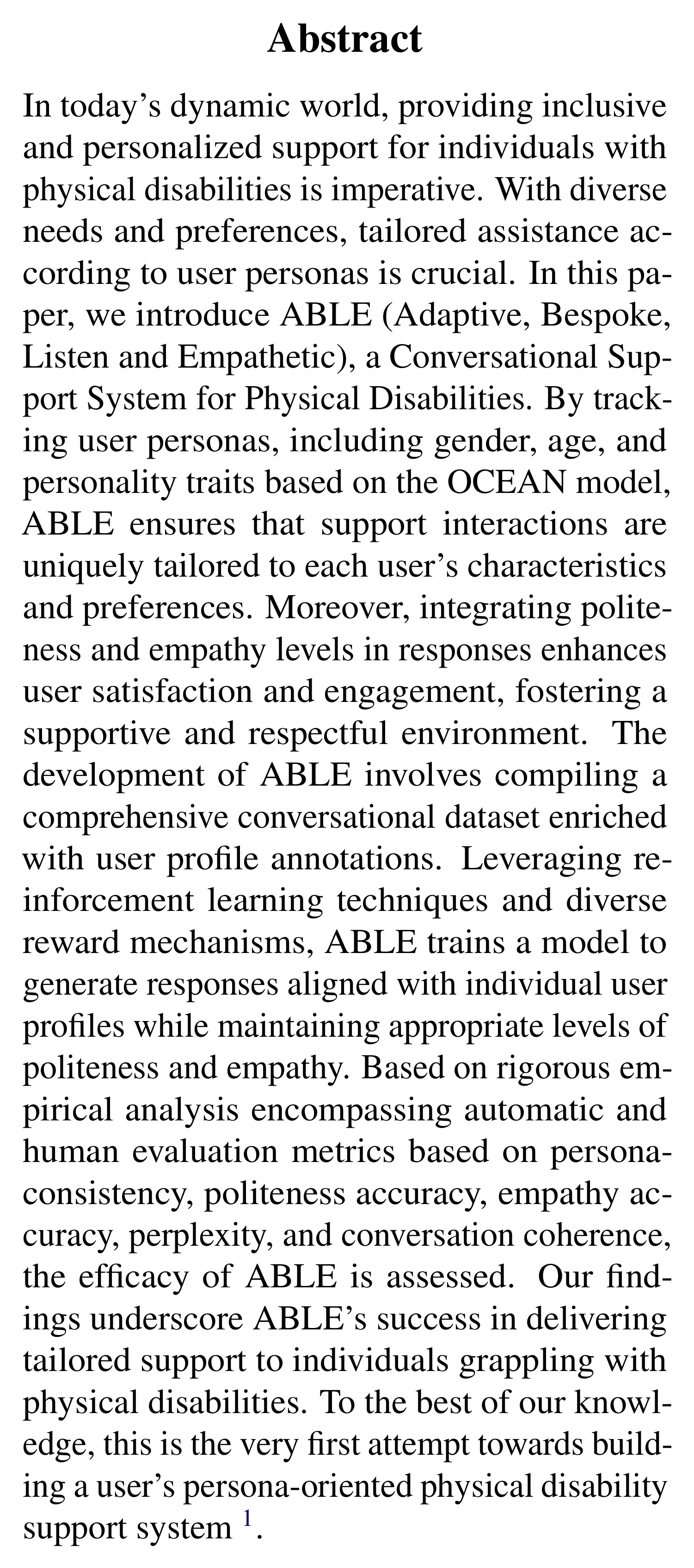
ABLE trains an AI system to tailor disability-support conversations to user profiles, with politeness and empathy assessed in synthetic dialogues.
A supportive conversational system needs more than a courteous tone. It also has to respond to what a person asks, maintain context and avoid inventing critical information. ABLE is a research system designed to tailor support conversations for people with physical disabilities using user profiles and politeness and empathy goals.
A synthetic dialogue dataset and reward-based model
The authors create PERPDSCD, a dataset of 18,026 dialogues covering topics such as mobility aids, home modifications, physical therapy, employment and social interaction. Conversations are generated with GPT-3.5 and human intervention. User profiles include gender, age and personality traits represented with the OCEAN framework: openness, conscientiousness, extraversion, agreeableness and neuroticism. The team then trains ABLE using reinforcement learning and six reward signals intended to support persona consistency, politeness, empathy, fluency and conversational quality (dataset and system design, PDF pp. 2–6; proceedings pp. 22446–22450).
The paper compares ABLE with eight baseline systems using automatic measures and human ratings. In Table 2, ABLE records 61.5% persona consistency, 74.0% gender–age accuracy, 87.6% politeness accuracy and 85.8% empathy accuracy. It also has the best listed perplexity and repetition figures among the compared systems. Table 3 reports higher human ratings on the study’s seven measures; the authors state that ABLE differs significantly from the other models in the automatic evaluation (results, Tables 2–3, PDF pp. 7–9; proceedings pp. 22451–22453).
Those measures evaluate generated benchmark conversations. They do not show that users with disabilities found the system helpful in real settings, or that politeness and empathy scores capture the full quality of support. The dataset is synthetic and profile-driven, so it cannot represent the complete variety of individual preferences and lived experience.
Where the system still falls short
The authors report persona mismatches, inconsistent politeness or empathy, and occasional loss of coherence. They also warn that a Phi-2-based system can hallucinate and may respond out of context to very short follow-ups. They call for grounding critical information and acknowledge that their metrics cover only some aspects of dialogue quality (error analysis and limitations, PDF pp. 8–10; proceedings pp. 22452–22454).
The study does not test these questions with a cohort of people seeking disability support. Its contribution is a benchmark and system design in which response style is measured alongside profile consistency. That gives future evaluations a concrete starting point, while leaving lived experience and user-defined goals central to judging usefulness.
Possible implications for accessible AI
ABLE makes personalization and interaction style explicit parts of system design, rather than treating every user as interchangeable. The results suggest that those goals can be measured in a controlled dataset. Further research with people who use disability-support services could clarify whether the synthetic benchmarks reflect needs, autonomy and preferences in actual conversations.
Bibliography & sources
- Kshitij Mishra, Manisha Burja, and Asif Ekbal. “ABLE: Personalized Disability Support with Politeness and Empathy Integration.” In Proceedings of the 2024 Conference on Empirical Methods in Natural Language Processing, 22445–22470 (2024). https://doi.org/10.18653/v1/2024.emnlp-main.1252.