
AI and workplace learning
ACE: A LLM-based Negotiation Coaching System
A negotiation coach combines role-play with targeted feedback and reports improved performance across two practice trials.
Practice alone may not teach negotiation tactics
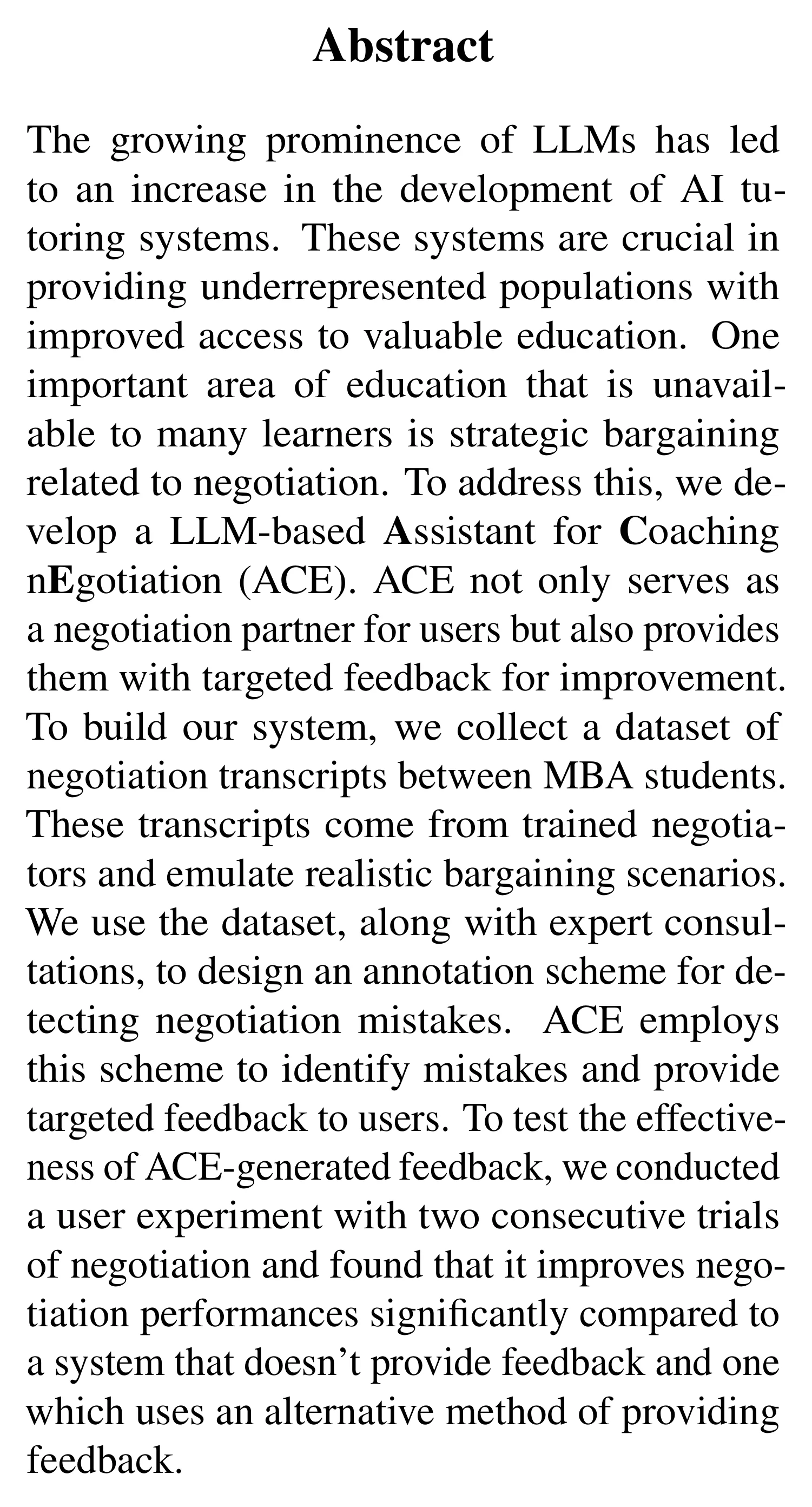
Negotiation is often learned through role-play, but an exercise without feedback may not reveal which choices helped or hurt. ACE, a language-model-based negotiation coach, pairs simulated bargaining with targeted feedback on preparation and conversational tactics. In a user experiment involving 374 participants, the researchers report that people receiving ACE’s feedback improved more across two negotiation trials than those receiving no feedback or an alternative form of feedback.
ACE is designed for single-issue distributive bargaining: a buyer and seller negotiate over one item, such as a used car. Before the role-play, the learner sets a target price, a maximum walk-away price and an opening offer. The system then simulates the other side and reviews both the preparation answers and the conversation. Its feedback rubric was developed with negotiation experts and identifies eight potential mistakes, including weak counteroffers, missing rationale and failing to close strategically.
A coaching rubric grounded in actual transcripts
The team began with recordings of MBA students in a negotiation course. Of 42 collected conversations, 40 were usable; dialogues averaged 20.6 turns. Two researchers independently annotated 288 turns and reached Cohen’s kappa of .87, a measure of agreement beyond chance (page 12723). In this set, 36 of 40 conversations contained an error related to strategic closing. Fifteen of 40 buyers made a preparation error in setting a target price (Table 3, page 12723). Those patterns informed the feedback the system provides.
ACE includes GPT-4 as a negotiation counterpart, while the feedback module uses the rubric to point out issues in the learner’s own strategy. This is distinct from simply asking a language model to produce a general summary: the system links observations to defined tactics and offers specific suggestions. In the experiment, learners negotiated twice and were assigned to ACE feedback, a no-feedback control or an alternative feedback condition. The authors report significant improvement in negotiation performance for ACE relative to the comparison groups.
These results are promising but bounded. The underlying data come from a single MBA course and involve car-price bargaining, a structured buyer-seller task. The 374 participants’ two trials provide evidence about short-term practice, not whether skills persist or transfer to salary talks, procurement or multi-issue negotiations. The rubric also reflects a particular model of effective bargaining, including advice about opening offers and strategic closing. Such choices may fit one training goal better than another.
A role for AI in deliberate practice
ACE illustrates how AI tutoring may support practice when the task has observable behaviors, expert guidance and opportunities to try again. Its contribution is not merely a conversational partner; it provides a structured lens for reviewing performance. For organizations exploring simulation-based learning, the findings point to a useful question: whether feedback is tied to specific, teachable behaviors and whether improvement lasts beyond the training session. Evidence from broader negotiation settings and longer follow-up would help answer that question.
The paper therefore provides evidence about structured practice with an immediate feedback loop, rather than a claim that any conversational tutor improves negotiation. Its scenario design and scoring criteria delimit what “improvement” means here; transfer to real bargaining, other tasks or unsupervised use would need separate evaluation.
Bibliography & sources
- Ryan Shea, Aymen Kallala, Xin Lucy Liu, Michael W. Morris, Zhou Yu. 2024. “ACE: A LLM-based Negotiation Coaching System.” In *Proceedings of the 2024 Conference on Empirical Methods in Natural Language Processing*, 12720–12749. Association for Computational Linguistics. https://doi.org/10.18653/v1/2024.emnlp-main.709.