
Generative AI and the nature of work
AI Copilot access reduced email time by 12%
Email time fell in a randomized Copilot rollout across 66 firms. The study also tracked adoption, meetings and document work.
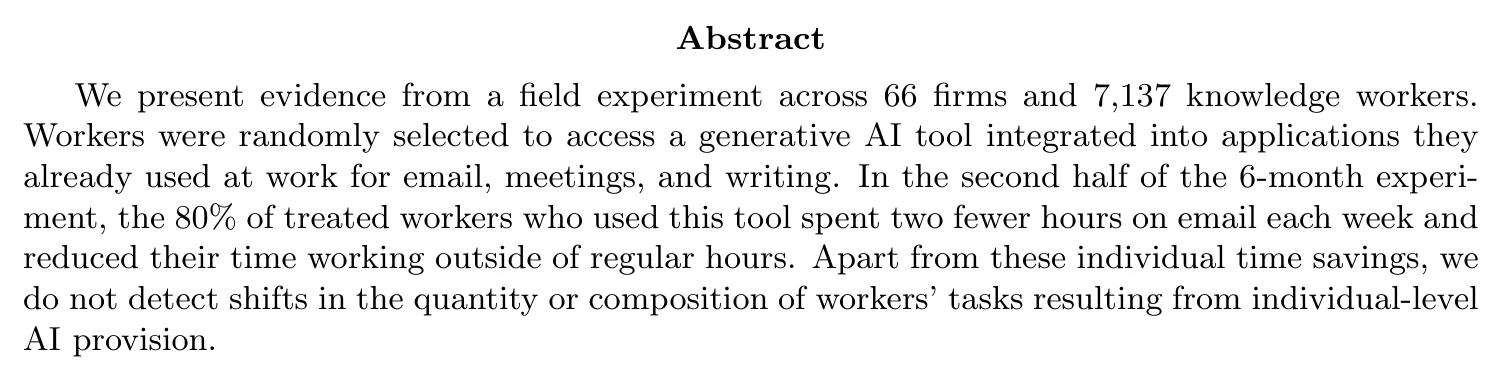
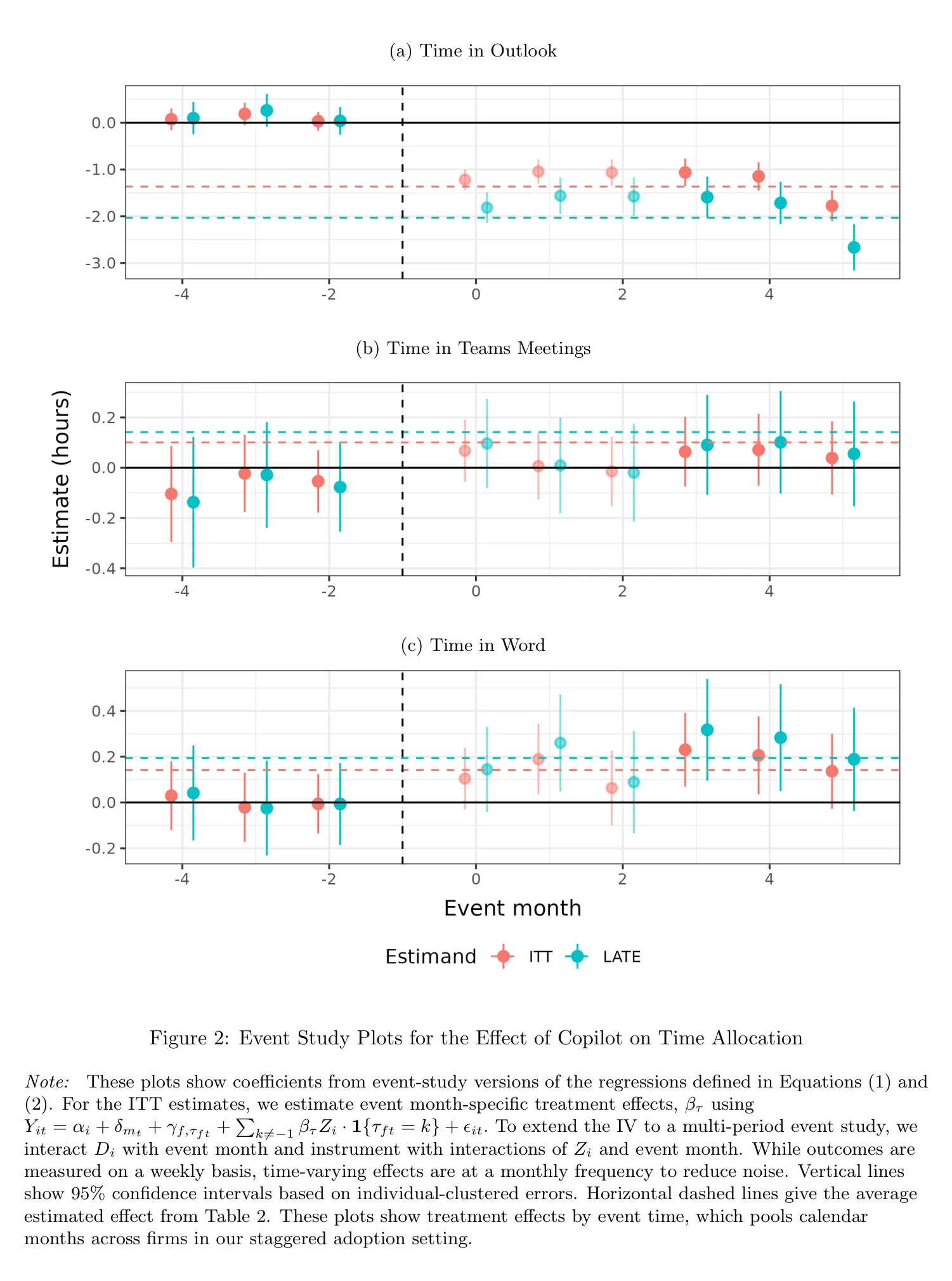
Workers offered Microsoft 365 Copilot spent about 1.4 fewer hours a week in Outlook—a 12% reduction. That result comes from a randomized field experiment involving 7,137 workers across 66 firms. Meeting and document activity changed little on average.
The study follows both time allocation and adoption, offering an early view of how AI enters established workplace routines.
How the researchers measured work
In Shifting Work Patterns with Generative AI, Eleanor Wiske Dillon, Sonia Jaffe, Nicole Immorlica and Christopher T. Stanton studied Copilot access during its 2023–2024 rollout. Copilot was integrated into Outlook, Teams and Word. The researchers followed application activity before and after workers received access, with the main results covering months four through six.
The arXiv v4 preprint was published on 13 November 2025. Three authors work at Microsoft Research, and the experiment was conducted with Microsoft.
Email took less time
The email-time analysis covered 6,441 workers. Table 2 reports two estimates:
| Estimate | Weekly reduction in Outlook session time | Population represented |
|---|---|---|
| Offer of Copilot access | About 1.4 hours, or 12% | Workers assigned access, including those who used it infrequently or never |
| Adoption induced by the offer | About 2.0 hours, or 17% | Workers whose adoption changed because they were assigned access |
The second estimate uses random assignment to account for differences in take-up. It describes the effect for workers whose adoption was influenced by the offer.
Workers offered Copilot also gained about 1.5 hours of email-free time during the working week. The number of unique email threads they replied to stayed broadly similar. Across the measured applications, their out-of-hours session time fell by about 15 minutes a week.
Meeting and document routines were largely unchanged
Average changes in Teams meeting time and Word session time fell below the study's significance threshold after adjustment for multiple tests. The broader measures of task activity, including meetings attended and documents completed, also showed little change.
Use of Copilot varied considerably. More than 90% of workers assigned access tried it during the experiment. Later, around 40% used it in a typical week. Usage differed substantially across firms.
The gap between initial trials and weekly usage shows how uneven adoption was during the rollout.
Study context
The participating firms were large, used Microsoft extensively and opted into an early-adopter study. The results reflect the tools available during 2023–2024. Application telemetry measures activity inside Outlook, Teams and Word; work quality, overall productivity and financial returns require separate assessment. Some document outcomes also had limited statistical power.
Possible implications for practice
Time savings from integrated AI may emerge first in familiar individual tasks. Meeting and document routines remained largely stable during the same rollout, pointing to different patterns of change across activities.
For managers and practitioners, these findings raise the prospect of an uneven transition: time spent on some tasks falls while shared routines persist. Differences in sustained use also raise questions about how workplace conditions shape the benefits employees experience.
Over longer periods, task-level time savings could influence how work is allocated and coordinated. How employees use the saved time, and whether team routines eventually change, remain important questions for understanding AI's organizational effects.
Bibliography & sources
- Dillon, Eleanor Wiske; Jaffe, Sonia; Immorlica, Nicole; and Stanton, Christopher T. (2025). Shifting Work Patterns with Generative AI. arXiv:2504.11436v4. Published preprint, 13 November 2025. Source paper