
Generative AI and knowledge work
A better blend for retrieval-augmented AI
BlendFilter combines query enrichment and document filtering to address two common sources of weak retrieval-augmented answers.
A search system can return a pile of documents and still leave a language model without the answer it needs. The authors of BlendFilter target two points in that chain: the wording of a complex query and the relevance of retrieved material.
Enrich the question, then filter the evidence
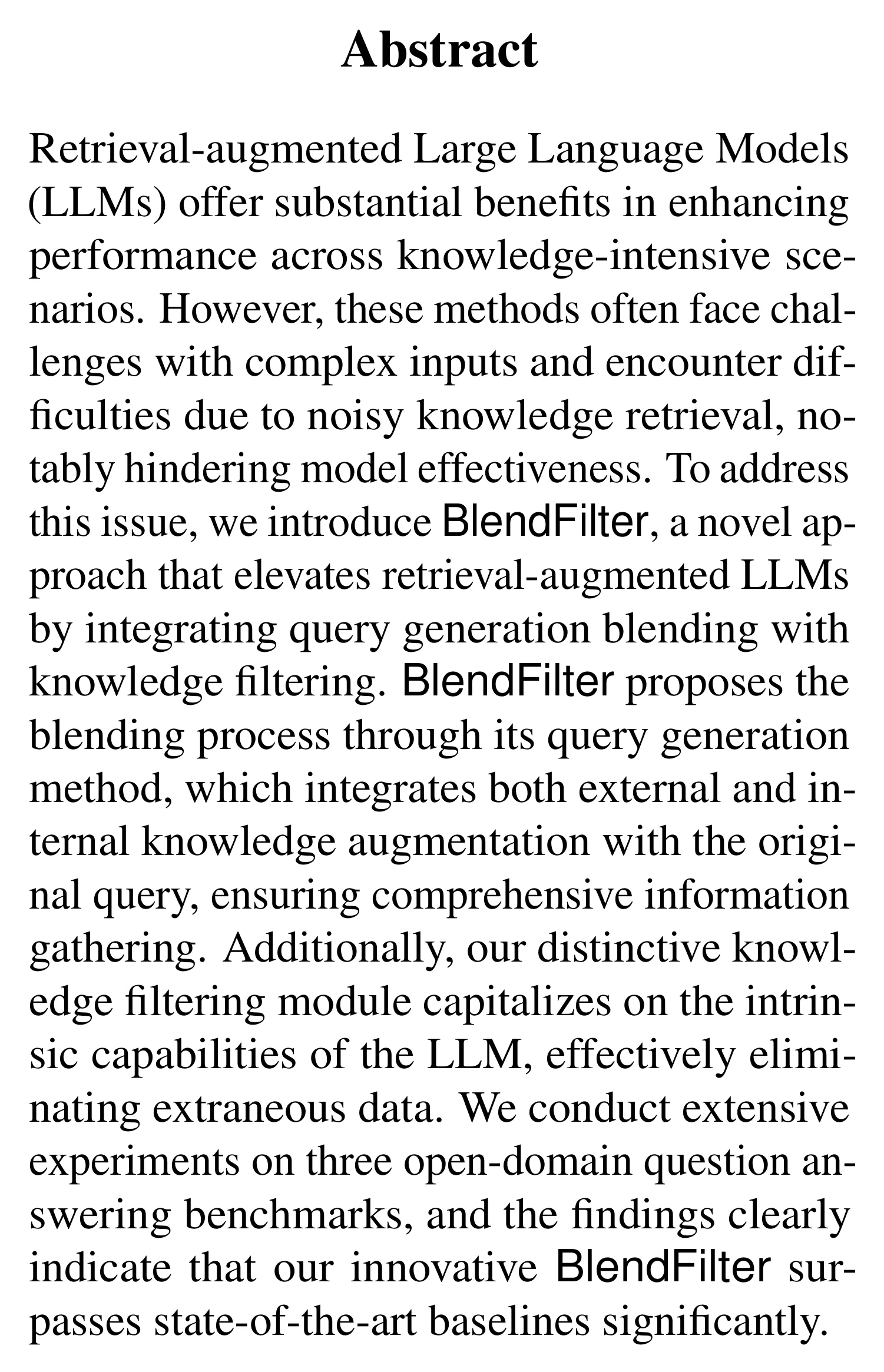
BlendFilter is a retrieval-augmented generation (RAG) method. RAG retrieves documents from an external collection and provides them to a language model as context. The system first creates expanded queries that combine the user's original question with information generated from both the model's internal knowledge and an external source. It uses those different queries to retrieve candidate documents. A knowledge-filtering step then uses the language model to remove material it judges extraneous before answer generation. Keeping the original query in the blend is intended to reduce the information loss that can occur when a rewritten query replaces the user's wording.
The paper tests the approach on three open-domain question-answering benchmarks. Results are reported with GPT-3.5-turbo-Instruct, Vicuna 1.5-13B and Qwen-7B (Tables 1–3, PDF p. 6), with an additional comparison in Table 4 (PDF p. 7). Across the tested settings, the authors report that BlendFilter exceeds strong baseline methods. The paper's ablation analysis examines the effects of removing components, and its filtering analysis measures retrieval outcomes (Table 5 and Figure 2, PDF pp. 7–8). The evidence therefore concerns benchmark answering quality and retrieved knowledge, not performance inside a live corporate search service.
The two-stage design responds to different failure patterns. A complex question can omit terms that help a retriever locate relevant records. Retrieved material can also include noise that distracts the answer model. Blending queries aims to broaden coverage; filtering aims to narrow the context that reaches generation.
A promising pattern, with evaluation boundaries
The authors describe experiments on three benchmarks and compare multiple language-model backbones. Those tests provide evidence about the proposed method under the paper's retrieval setup. They do not show how the system behaves with every search index, private document collection, query type or cost constraint. The limitations discussion appears on PDF p. 9. In particular, results from benchmark retrieval depend on the datasets, base models and filtering process used in the experiment.
For managers, search quality often depends on both finding a useful source and presenting the right part of it to the answer generator. BlendFilter illustrates an approach that treats query reformulation and evidence selection as connected stages. The benchmark findings could inform evaluations of retrieval design, while leaving operational issues such as permissions, source freshness and review effort to separate assessment.
Possible implications for practice
The paper suggests that retrieval failures can have more than one cause. A missing keyword and a distracting document call for different remedies. A combined strategy may be worth examining where question answering depends on varied or detailed queries, though the measured benchmark gains do not establish what a particular organization would experience.
Bibliography & sources
- Haoyu Wang; Ruirui Li; Haoming Jiang; Jinjin Tian; Zhengyang Wang; Chen Luo; Xianfeng Tang; Monica Xiao Cheng; Tuo Zhao; Jing Gao (2024). “BlendFilter: Advancing Retrieval-Augmented Large Language Models via Query Generation Blending and Knowledge Filtering.” Proceedings of the 2024 Conference on Empirical Methods in Natural Language Processing, pp. 1009–1025. DOI: 10.18653/v1/2024.emnlp-main.58. Source paper