
AI and commerce
AI Answers Cross-market Product Questions Across 11 Languages
A multilingual benchmark tests whether product reviews and questions from one marketplace can help answer questions in another.
A shopper’s question in one country may have no useful answer in that local marketplace, even when buyers elsewhere have reviewed the same product. Yifei Yuan and colleagues study whether information from a larger market can help answer product questions in another language and marketplace.
Moving product knowledge across markets
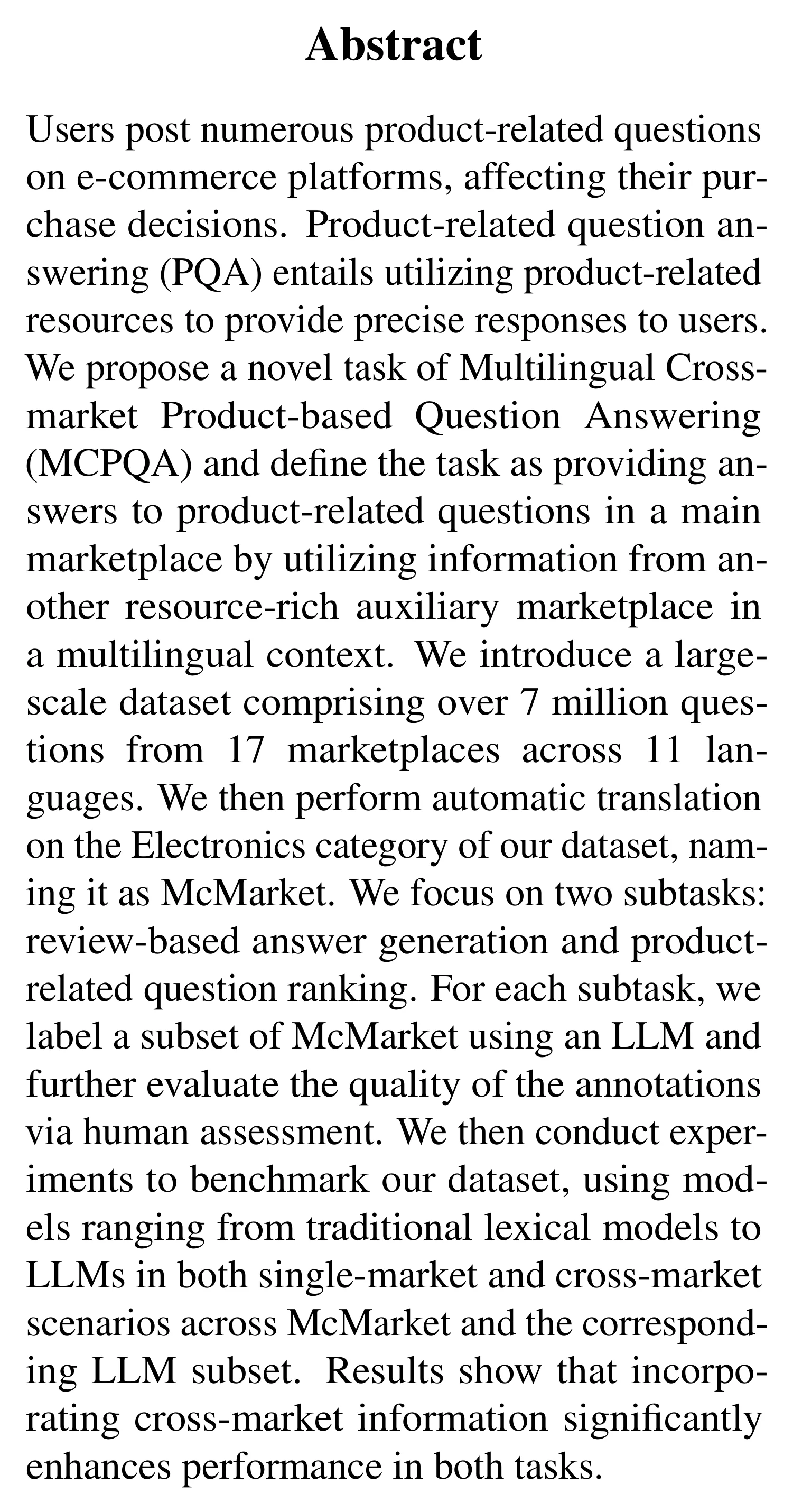
The paper defines multilingual cross-market product-based question answering (MCPQA) and introduces a dataset with more than seven million questions, 52 million reviews and 143,000 products across 17 marketplaces and 11 languages. For experiments, the authors automatically translated the Electronics category into a resource called McMarket. They examine two tasks: answer generation from reviews and ranking related product questions that might help answer a shopper’s question (Yuan et al., 2024, pp. 11154–11158).
The team created two smaller subsets with labels generated by GPT-4 and then assessed by people. On the answer-generation subset, human assessors judged 61.8% of GPT-4 answers better than the human-provided ground truth. Generated answers used review text alone, while the human reference could draw on both reviews and a shopper’s own experience (pp. 11155–11157). For question ranking, assessors marked more than 93% of pairs correct, with an overall F1 score of 97.6% for the ranking evaluation (p. 11158).
In model comparisons, cross-market information generally helped systems on resource-scarce marketplaces across both tasks. The paper tests approaches ranging from lexical retrieval to language models and compares single-market with cross-market settings (Tables 5–8, pp. 11159–11162). Reviews and related questions from another marketplace can supply evidence unavailable locally; they do not establish that every imported answer suits every shopper.
What a good answer depends on
Product reviews are user-generated data. They can be inaccurate, biased or out of date, and a review’s usefulness depends on whether it describes the same product version and relevant market context. Automatic translation adds another layer: translated category data may preserve some information while changing nuance. The authors acknowledge these quality and language barriers, especially for lower-resource languages (Yuan et al., 2024, pp. 11168–11169).
The human judgments are based on selected subsets and specific tasks. “Better than the ground truth” is an assessor comparison under the study’s criteria; it does not mean every answer is correct or that user experience improved. The labels generated by GPT-4 are silver annotations—machine-produced guidance that still requires assessment (pp. 11155–11158).
Possible implications for practice
For commerce platforms, the study illustrates how product information may travel across markets to fill gaps in local data. That could expand coverage for shoppers who ask questions in languages with fewer reviews. It also raises whether an imported review reflects local product variants, regulations, terminology or expectations.
A cross-market answer system may need to reveal where its evidence came from and how closely it matches the item being asked about. Product teams could evaluate not only whether an answer reads well, but whether cited reviews refer to the right product and community. The paper’s benchmark offers a way to test these systems, while leaving real-world trust and purchasing effects for future study.
The distinction between answer generation and question ranking also matters for product design. A system might first surface related questions rather than compose a new response, giving users a chance to inspect the source material themselves. The study compares both tasks but does not test that interface choice with shoppers. Local feedback would be needed to learn whether an answer or a set of linked reviews better supports purchase decisions.
Bibliography & sources
- Yifei Yuan; Yang Deng; Anders Søgaard; Mohammad Aliannejadi. 2024. “Unlocking Markets: A Multilingual Benchmark to Cross-Market Question Answering.” In *Proceedings of the 2024 Conference on Empirical Methods in Natural Language Processing*, 11154–11169. Association for Computational Linguistics. https://doi.org/10.18653/v1/2024.emnlp-main.625.