
Generative AI in organizations and society
AI crypto agents combine market data, news and reflection
CryptoTrade combines blockchain activity, market indicators and financial news. Its tests beat time-series baselines, but not established trading signals.
Can a language model make better cryptocurrency trades by reading market data and news together? CryptoTrade tests that idea with an agent that also reviews its earlier decisions. The result is promising against forecasting models, but less compelling beside familiar trading rules.
Three kinds of information, several agent roles
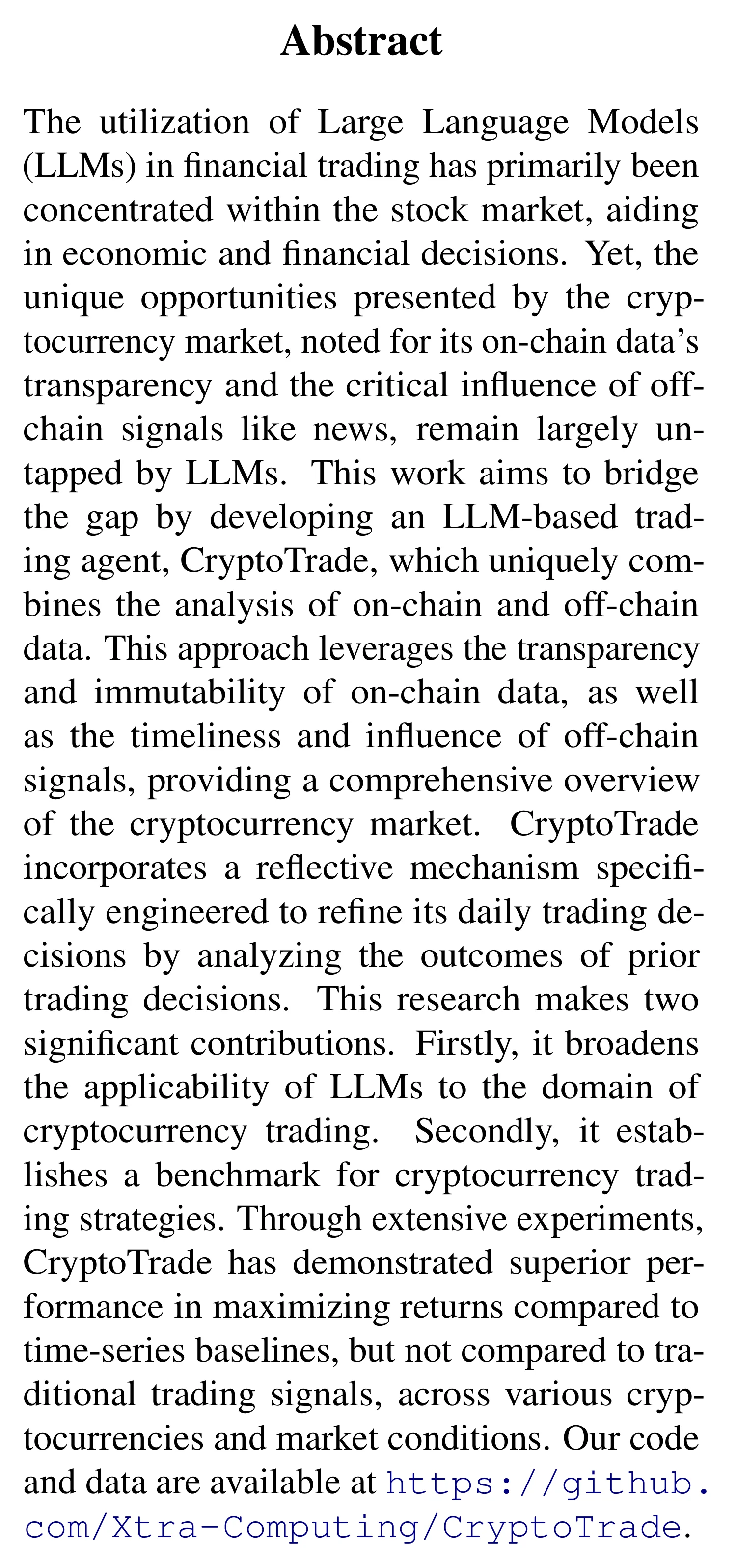
CryptoTrade combines on-chain signals, such as transaction activity and market statistics, with off-chain financial news. The system summarizes articles and calculates indicators such as moving averages. Separate language-model agents interpret market trends, news and trading choices; a reflection agent reviews the results of earlier decisions. In this paper, “reflection” means storing written observations about prior trades and using them to inform later choices, rather than updating the model’s weights (PDF pp. 1–2; proceedings pp. 1094–1095).
The team evaluates GPT-3.5-Turbo, GPT-4 and GPT-4o on Bitcoin, Ethereum and Solana. Tests cover bullish, sideways and bearish periods. The agent acts once a day and works without fine-tuning on a validation set. That zero-shot design tests an approach that does not learn parameters from market-specific examples before evaluation (methods and split definitions, PDF pp. 4–7; proceedings pp. 1097–1100).
Stronger than forecasting baselines, not the market’s best rules
The reported results show CryptoTrade outperforming time-series forecasting baselines such as Informer and PatchTST on returns and risk-adjusted performance in several market settings. Its results are closer to technical trading signals, including the moving-average convergence/divergence rule. The authors’ abstract and conclusion are explicit that the agent does not consistently beat traditional strategies such as buy-and-hold and short/long moving averages (results, Table 2 and following analysis, PDF pp. 8–11; proceedings pp. 1101–1104).
That comparison matters. A result against forecasting models does not by itself show that an AI agent is a better investment strategy. Performance depends on the selected tokens, dates, news sources and trading assumptions. In one example, Ethereum’s buy-and-hold return in a bullish period was 22.59%, and CryptoTrade exceeded it by about three percentage points; that is one test period, not a general forecast (PDF p. 2; proceedings p. 1095).
What the experiment can and cannot say
The study uses a limited dataset, daily decisions and historical backtests. The authors identify limited off-chain information and trading frequency as constraints, and acknowledge that their models were not fine-tuned. Past simulated results do not establish future profits or account for all live-market frictions. The paper itself says the system is for research, not investment recommendations (limitations and broader impact, PDF p. 12; proceedings p. 1105).
Possible implications for financial tools
For organizations exploring language models in finance, CryptoTrade is a useful example of combining structured signals with text and recording an agent’s reasoning across decisions. It also shows why comparisons need strong baselines and transparent time windows. Whether reflection adds reliable value beyond the data inputs remains a question for broader, prospective tests.
Bibliography & sources
- Yuan Li, Bingqiao Luo, Qian Wang, Nuo Chen, Xu Liu, and Bingsheng He. “CryptoTrade: A Reflective LLM-based Agent to Guide Zero-shot Cryptocurrency Trading.” In Proceedings of the 2024 Conference on Empirical Methods in Natural Language Processing, 1094–1106 (2024). https://doi.org/10.18653/v1/2024.emnlp-main.63.