
AI evaluation
What LLM Benchmarks Measure—and Where They Fall Short
A systematic review follows language-model evaluation from prompt setup to metrics, highlighting missing details and fragile comparisons.
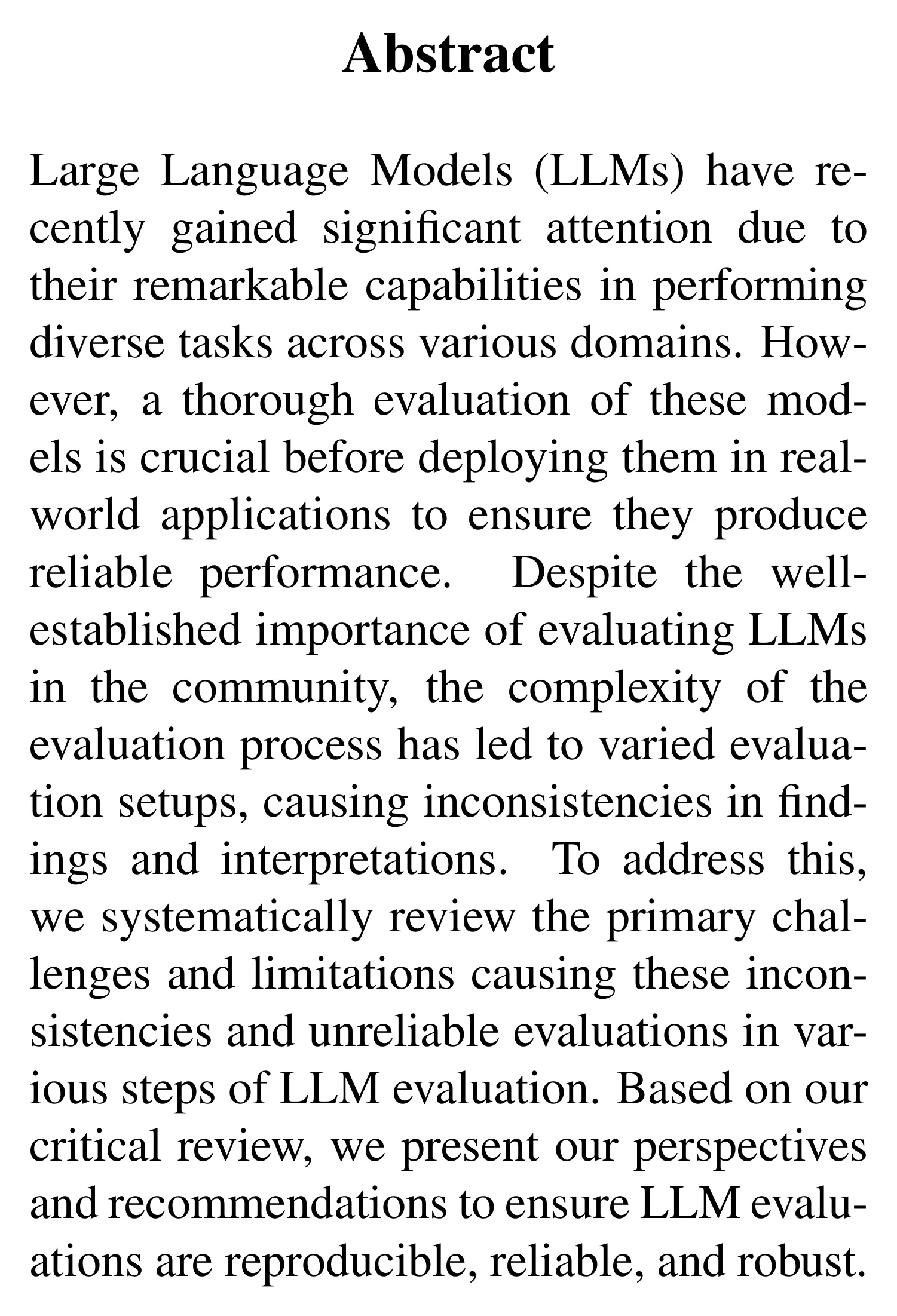
A benchmark score looks simple: ask a model questions, compare answers with a reference and report a number. But each step can change the result. A systematic survey by Md Tahmid Rahman Laskar and colleagues follows evaluation from setup through generation and measurement, showing how choices can make model comparisons hard to reproduce.
The whole evaluation pipeline matters
The authors organize challenges around three goals: reproducibility, reliability and robustness. Reproducibility depends on enough information to repeat an evaluation, including model versions, prompts, decoding settings and parsing rules. Reliability depends on whether test data and scoring reflect the task. Robustness asks whether conclusions hold when prompts, data or conditions change (Laskar et al., 2024, pp. 13785–13789).
The paper cites a review of 212 evaluation papers to illustrate reporting gaps: 90.6% included prompts, 53.3% released code, 50.0% included both prompt and code, and 29.3% reported model versions. In the comparison measure, 20.7% were classified as fair and 79.3% as unfair (Table 1, p. 13787). These percentages come from that prior analysis, not a new audit by Laskar and colleagues. The categories measure different kinds of transparency; code availability alone does not establish a fair comparison.
A score can fail before scoring begins
The review describes several sources of error. A benchmark may overlap with pretraining data, making a nominally unseen test less informative. Gold answers can become outdated on knowledge questions. Prompt selection or decoding settings can favor one model. Parsing scripts can misread verbose answers; one cited study found parsing errors can shift results by more than ten percentage points on some tasks (pp. 13788–13789).
Scoring also changes what “good” means. Exact-match measures are useful for short, fixed answers but can penalize valid wording differences. The paper discusses weak alignment between some automatic text measures and human preferences, as well as biases that can affect language models used as judges (pp. 13791–13792). These examples do not mean every benchmark is unreliable. They show why each metric needs evidence that it measures the intended outcome.
The article combines a workflow-based review with small demonstrations of problems such as prompt sensitivity and token coverage. Its contribution is a set of recommendations about documentation, benchmark integrity and human-aligned metrics, rather than a single replacement benchmark. The authors focus on text evaluation and mostly English-language studies; training-stage issues and multimodal evaluation receive less coverage (pp. 13794–13795).
Possible implications for practice
For organizations comparing vendors or models, a published score is only as useful as the choices behind it. Model version, prompt, data, scoring method and test-set freshness can all shape the ranking. Recording those settings can make an internal comparison easier to repeat when products change.
The paper also points toward a distinction between technical performance and task success. A metric may reward concise exact answers while a user needs a grounded explanation, or miss an answer that is semantically right but phrased differently. Teams may need more than one evaluation view, including human judgment where the consequences of a mistake are substantial.
A practical benchmark should be treated as a measurement instrument with an intended scope, not as a universal measure of capability. This review maps where measurement can drift; deciding which checks matter most still depends on the application and the cost of error. If a score is going to influence procurement or deployment decisions, the assumptions behind that score become part of the decision record, not just a technical footnote.
Bibliography & sources
- Md Tahmid Rahman Laskar; Sawsan Alqahtani; M Saiful Bari; Mizanur Rahman; Mohammad Abdullah Matin Khan; Haidar Khan; Israt Jahan; Md Amran Hossen Bhuiyan; Chee Wei Tan; Md Rizwan Parvez; Enamul Hoque; Shafiq Joty; Jimmy Xiangji Huang. 2024. “A Systematic Survey and Critical Review on Evaluating Large Language Models: Challenges, Limitations, and Recommendations.” In *Proceedings of the 2024 Conference on Empirical Methods in Natural Language Processing*, 13785–13816. Association for Computational Linguistics. https://doi.org/10.18653/v1/2024.emnlp-main.764.