
AI governance and society
Whose values do language models reflect?
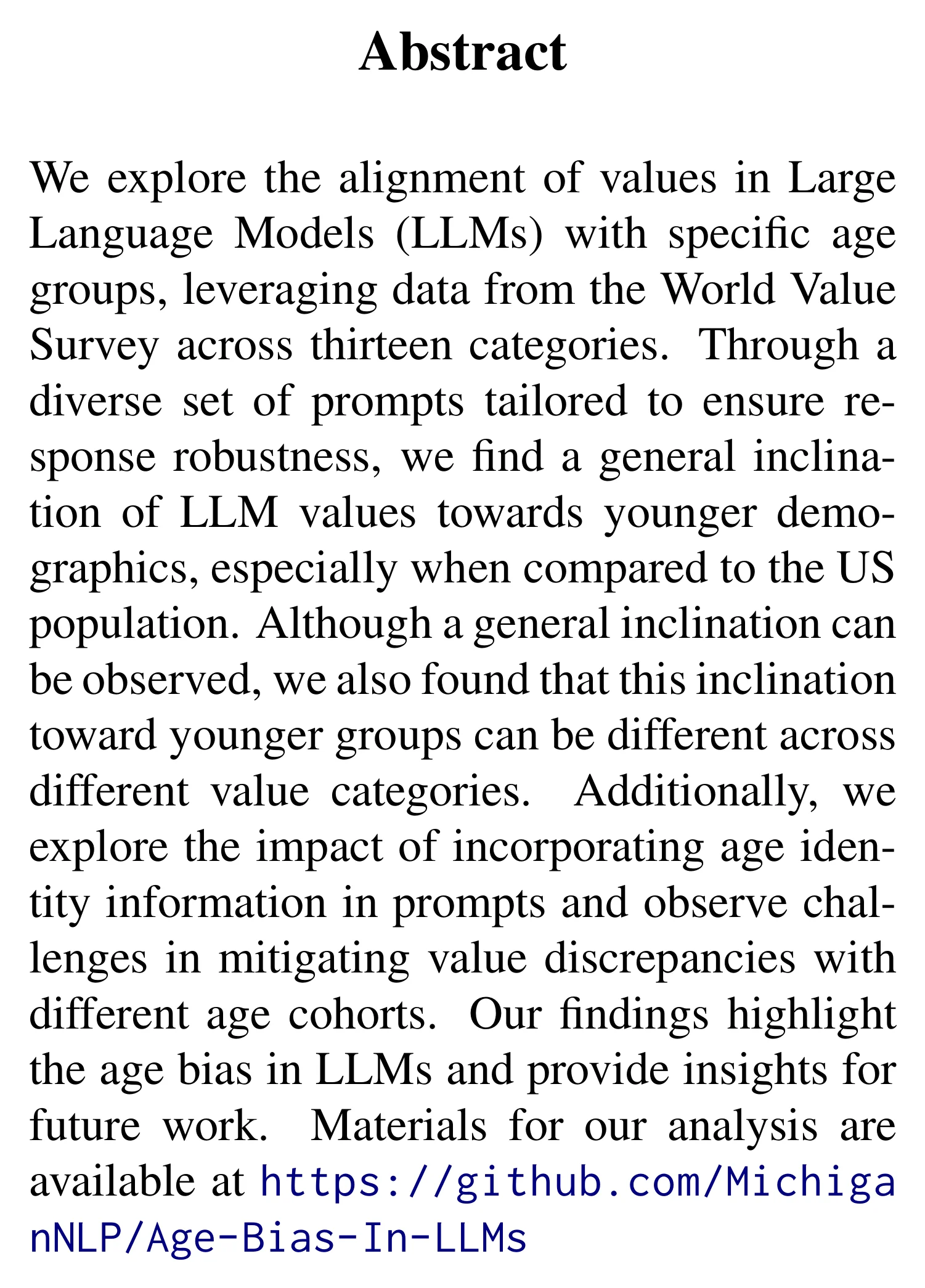
A comparison with World Values Survey responses finds that tested models tended to align more closely with younger groups, with differences across value topics.
When an AI assistant answers a question about family, religion or social change, whose values does its response resemble? Liu and colleagues compare language models’ responses with survey data from different age groups. Their analysis highlights age as a dimension of model alignment that can get lost when developers focus on a single “average” user.
Comparing model answers with survey patterns
The researchers use the World Values Survey, a large international study of social and personal values, to compare language model responses with human groups across thirteen categories. They test six models using varied prompts intended to check whether patterns persist across ways of asking. The team calculates distances between model and human value profiles, then compares how those gaps vary by age.
The paper also tests prompts that provide age-identity information, asking whether a model’s answers move closer to a targeted age cohort. This helps separate a broad alignment pattern from the effect of an explicit instruction. The analysis includes multiple countries, while the highlighted comparisons focus on the United States (methods, proceedings pages 19619–19622).
Models leaned toward younger groups
Across the thirteen categories, the authors find a general inclination toward younger demographic groups, especially compared with the US population. The degree of alignment varies by topic: a model can resemble younger respondents on some values and differ on others. Adding age identity to prompts does not reliably erase the value gap; the authors describe challenges in matching a specified age group (abstract and results, proceedings pages 19617 and 19622–19628).
The study measures similarity between questionnaire-based response profiles. It does not establish that a model has a stable personal worldview, or that every user from a given age group shares one set of values. Survey responses are a population-level comparison, not a description of individual people.
Representation in everyday AI
For organizations designing public-facing assistants, age can shape whether a response feels relevant or respectful. A system tuned toward the preferences of one demographic could create a mismatch for people with different experiences. The study offers a way to examine that mismatch empirically rather than assuming that a general-purpose response works equally well for everyone.
The analysis compares six models with seventh-wave World Values Survey responses across 13 value categories, using eight prompt formats and six age groups. Adding an explicit age identity did not close the gap in eight of 13 categories. The authors also note that model responses sometimes resembled no single human age cohort, and that prompt resources and questionnaire design constrain conclusions. Thus the younger-value tendency—especially against the U.S. population—is an aggregate pattern, not a claim that every answer or model represents one age group (Table 5, Figure 4; Appendices A–G).
Study limits
The authors note that their focus is on relative inclination, not the absolute distance between models and human values. They rely on World Values Survey questions, which were not designed specifically to measure age differences. Time and cost also limited the range of age-alignment prompts they could test (limitations, proceedings pages 19628–19629).
Possible implications for practice
The findings suggest that alignment evaluations could compare responses across age groups and value areas, especially for tools used by diverse populations. Further research could establish whether the observed questionnaire patterns predict real interaction quality, and whether age-aware prompting changes outcomes consistently across cultures.
Bibliography & sources
- Siyang Liu, Trisha Maturi, Bowen Yi, Siqi Shen, and Rada Mihalcea. “The Generation Gap: Exploring Age Bias in the Value Systems of Large Language Models.” In Proceedings of the 2024 Conference on Empirical Methods in Natural Language Processing, 19617–19634 (2024). https://doi.org/10.18653/v1/2024.emnlp-main.1094.