
AI and human-centered research
HEART-felt Narratives: Tracing Empathy and Narrative Style in Personal Stories with LLMs
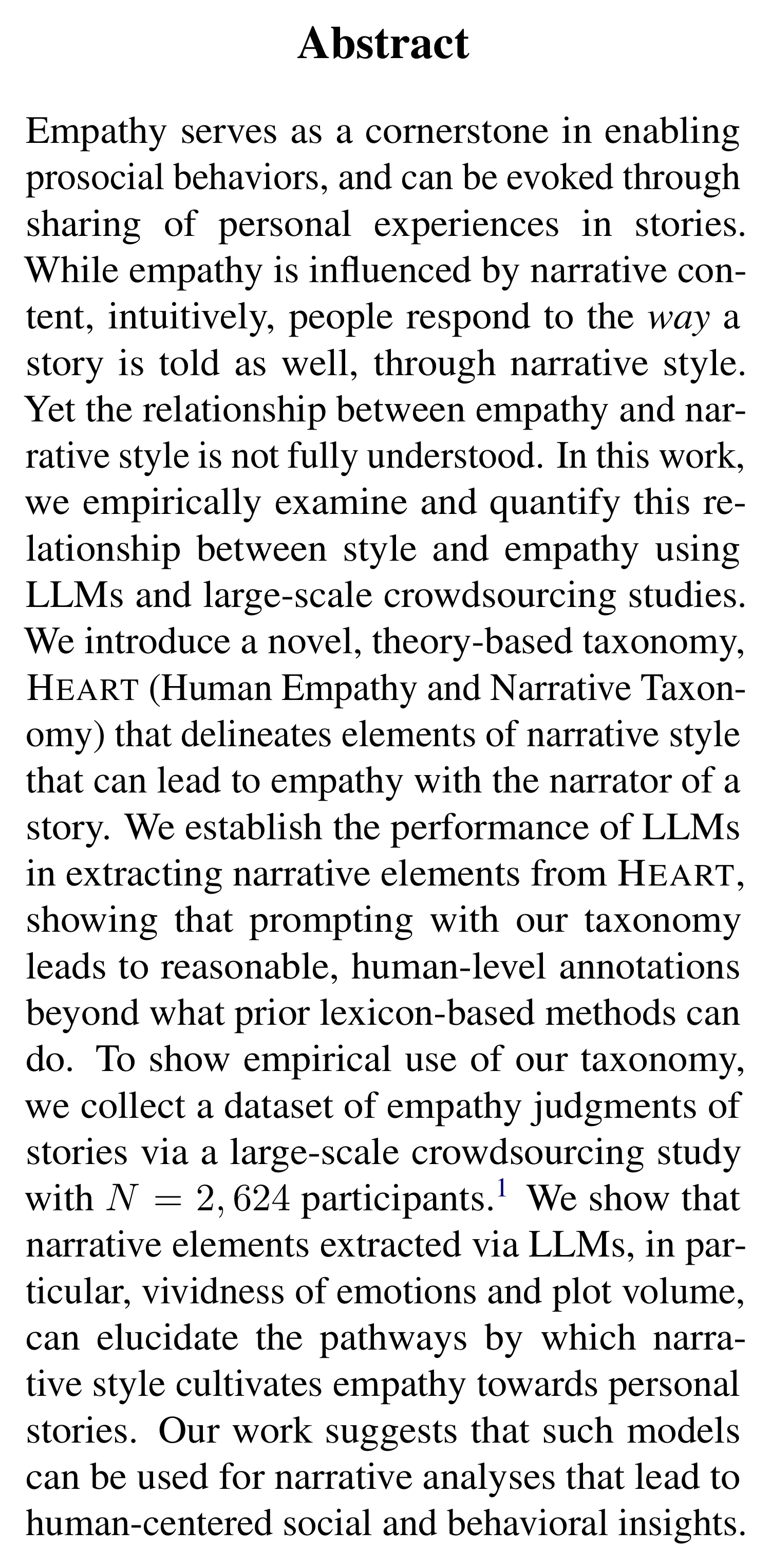
Researchers used GPT-4 to label 874 personal stories. Readers reported more empathy for stories with greater character development and more plot events.
Why the telling of a story matters
Two people can recount similar events and still evoke different reactions. A story’s details matter, but so may its style: how vividly the narrator describes feelings, whether the character changes, and how many meaningful events unfold. The HEART-felt Narratives study introduces a taxonomy for describing those features and tests how they relate to readers’ reported empathy.
HEART stands for Human Empathy and Narrative Taxonomy. It organizes features into character identification, plot, point of view and setting. Examples include character vulnerability, vividness of emotion, plot volume and resolution. The researchers first asked two trained annotators to rate 50 stories, then compared those judgments with ratings from GPT-4 and Llama 3. GPT-4 aligned most strongly with human judgments for character vulnerability (Krippendorff’s alpha 62.89 on a 0–100 scale) and optimistic tone (50.97; Table 2, page 1031). Agreement varied considerably by feature.
Readers respond to style—and to each other
The team applied GPT-4 to 874 personal narratives and collected empathy judgments from 2,624 participants. Each story received at least three independent reader ratings. The authors found that stories with higher character development and plot volume had higher average empathy ratings; both differences remained statistically significant after correcting for multiple comparisons (p=.03; page 1033). In a structural equation model, vivid emotional expression was associated with stronger narrative transportation—the feeling of becoming absorbed in a story—which was in turn associated with reported empathy (Figure 4, page 1033).
The study also finds that empathy is not a fixed property of a story. Readers’ prior experience and trait empathy were associated with their reactions, and the same narrative prompted different responses from different people. The link between vivid emotion and empathy was stronger among readers with higher trait empathy. These results caution against treating one average “empathy score” as the universal response to a piece of writing.
The findings are associations, not proof that adding a vivid sentence or an extra plot event will cause readers to feel more empathy. The corpus consists of English personal narratives, and the expert validation set is small. Some features, including cognition and bodily sensations, were difficult for human annotators to rate consistently. GPT-4 also tended to mistake emotional reactions for reflective thought in some stories. These constraints limit how precisely the measured categories capture the experience of reading.
Implications for communication research
For teams studying employee stories, customer accounts or public narratives, HEART offers a more detailed vocabulary than word counts alone. It also points toward a research design that includes reader differences rather than attributing every reaction to message content. A practical implication is methodological rather than prescriptive: an AI-generated style annotation can help organize a large collection, but should be interpreted alongside human judgments and audience context. The central finding is that narrative style and reader experience are intertwined, not that a single formula can make a story universally persuasive or moving.
In interpreting these observations, keep the study’s sampled narrative material and experimental conditions in view: audience reactions to these prompts do not establish a stable empathy trait, nor do they predict every reader’s response. The result is best understood as a comparison within the authors’ evaluation setup.
Bibliography & sources
- Jocelyn Shen, Joel Mire, Hae Won Park, Cynthia Breazeal, Maarten Sap. 2024. “HEART-felt Narratives: Tracing Empathy and Narrative Style in Personal Stories with LLMs.” In *Proceedings of the 2024 Conference on Empirical Methods in Natural Language Processing*, 1026–1046. Association for Computational Linguistics. https://doi.org/10.18653/v1/2024.emnlp-main.59.