
AI reliability
When a Language Model’s Knowledge Collides
A survey separates conflicts between prompts, retrieved sources and model memory—and explains why resolving them is context-dependent.
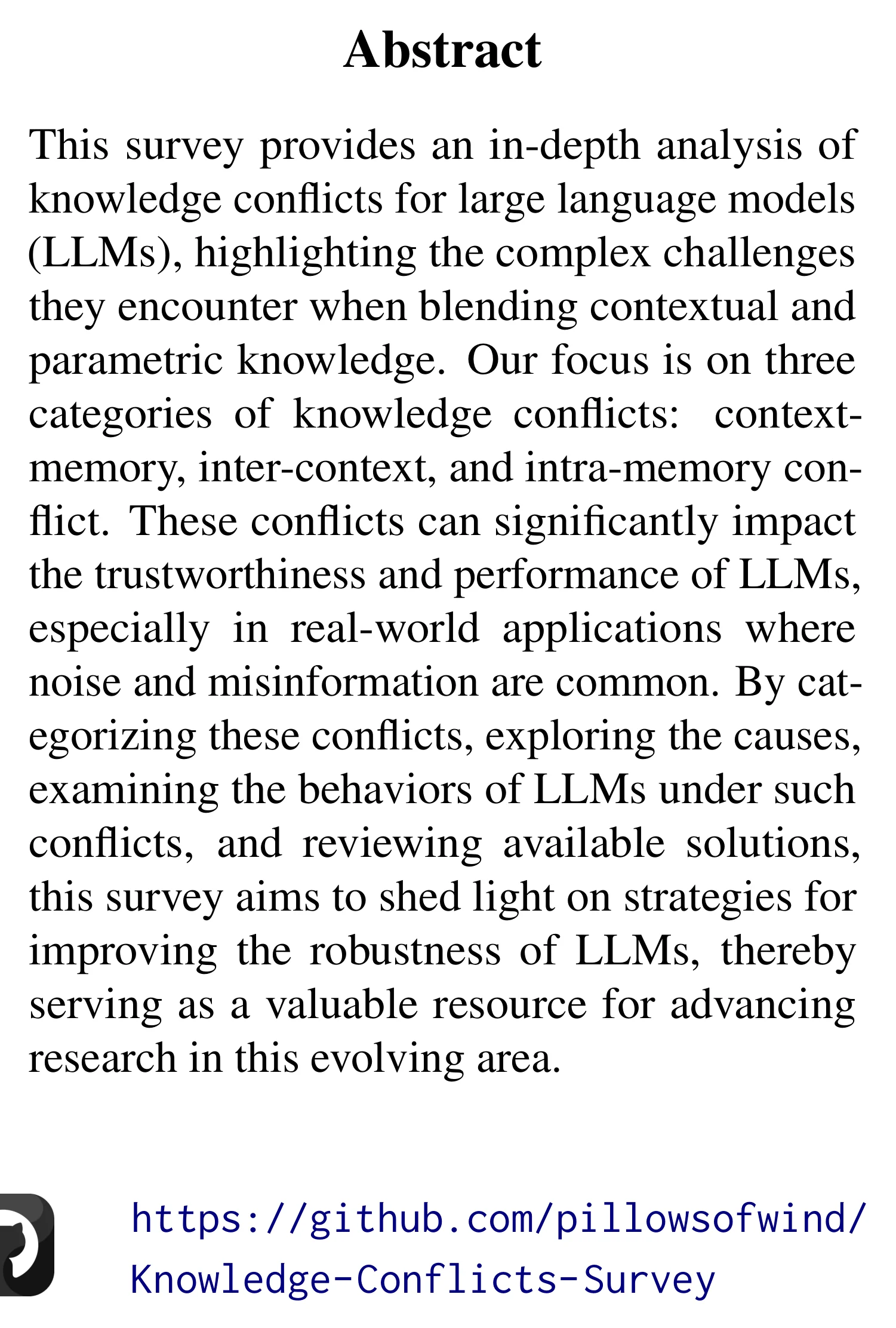
A language model may answer from what it learned during training, from documents supplied at the moment of use, or from both. When those sources disagree, the system must choose what to trust. A survey by Rongwu Xu and colleagues calls these cases knowledge conflicts and groups them into three types.
Three ways information can disagree
A context–memory conflict occurs when a prompt or retrieved document contradicts information represented in the model’s parameters. An inter-context conflict occurs when two supplied sources disagree. An intra-memory conflict appears when the model gives inconsistent answers to different phrasings despite drawing on its stored knowledge. The distinction matters because a model can behave differently depending on which sources conflict and how a question is asked (Xu et al., 2024, pp. 8541–8544).
For example, a retrieval system might present one page with current facts and another with outdated information. The model can also resist a correct document because its training data supports another answer. The survey reviews evidence that models sometimes follow misleading context and sometimes favor familiar or high-frequency information. It also describes inconsistencies in answers from the same model.
A map, not a new model contest
The authors searched literature on knowledge conflict, manually classified studies and organized their methods, behaviors and mitigation approaches. They did not run one new experiment comparing all techniques. Their appendices compile quantitative results from separate papers, including different models, datasets and knowledge snapshots (pp. 8549, 8563–8565).
Those compiled results illustrate possible scale, not a shared performance ranking. One study in the review found misinformation in context reduced performance by as much as 87% on its benchmark. Another reported GPT-4 inconsistency of 32% on FaVIQ (Table 2, p. 8564). These numbers concern different tasks and experiments. They are not estimates for a deployed assistant or proof that all systems behave the same way.
The survey reviews mitigation ideas such as prompting models to follow or assess evidence, training a discriminator to spot misinformation, and changing how answers are generated. Yet a strategy designed to favor supplied context may be undesirable when that context is unreliable. Conversely, always relying on model memory can leave a system stale. Some methods seek fidelity to context, while others seek detection of false information.
What remains unresolved
The review focuses on factual conflicts, especially in retrieval-augmented language models. It does not cover every kind of conflict, such as disagreements in reasoning, and it may miss fast-moving work. Cross-method comparisons are difficult because datasets, models and knowledge snapshots vary. The authors also point to multimodal conflicts, such as an audio clip contradicting a document, as a less-developed area (pp. 8548–8549).
Possible implications for practice
For practitioners, a retrieval source should not be treated as automatically authoritative just because a model can quote it. Source provenance, freshness and disagreement among documents could all affect the final answer. Systems that expose citations may still need ways to detect when their sources conflict or when the answer departs from them.
The survey suggests treating conflict handling as a design question rather than a single accuracy score. A useful evaluation would vary whether evidence is correct, misleading, contradictory or incomplete, then measure the model’s response and uncertainty. Which behavior is appropriate depends on the task: current policy guidance has different evidence needs from open-ended brainstorming. The survey gives a framework for asking those questions, while leaving the best trade-offs unresolved.
For managers, that framework could make incident review more specific. If an assistant gives a wrong answer, the failure may come from stale internal knowledge, a misleading retrieved page, conflicting documents, or unstable response behavior. Those sources call for different explanations and evidence. The paper does not prescribe one resolver, but its taxonomy may help teams distinguish whether a problem lies in source quality, retrieval design, or model behavior before treating all factual errors as one category.
Bibliography & sources
- Rongwu Xu; Zehan Qi; Zhijiang Guo; Cunxiang Wang; Hongru Wang; Yue Zhang; Wei Xu. 2024. “Knowledge Conflicts for LLMs: A Survey.” In *Proceedings of the 2024 Conference on Empirical Methods in Natural Language Processing*, 8541–8565. Association for Computational Linguistics. https://doi.org/10.18653/v1/2024.emnlp-main.486.