
Science and research
LLMs Assist NLP Researchers: Critique Paper (Meta-)Reviewing
Experts marked more passages as deficient in AI-written peer reviews than in human reviews. Model feedback was less specific to individual papers.
Can a large language model (LLM) write a useful paper review? A polished paragraph can still miss a paper’s central contribution, repeat the authors’ claims or overlook a technical flaw. In “LLMs Assist NLP Researchers: Critique Paper (Meta-)Reviewing,” the authors examine those differences instead of advocating that automated reviewers replace researchers. Their goal is to help recognize model-written review activity and to test where current systems fall short.
A dataset built around review quality
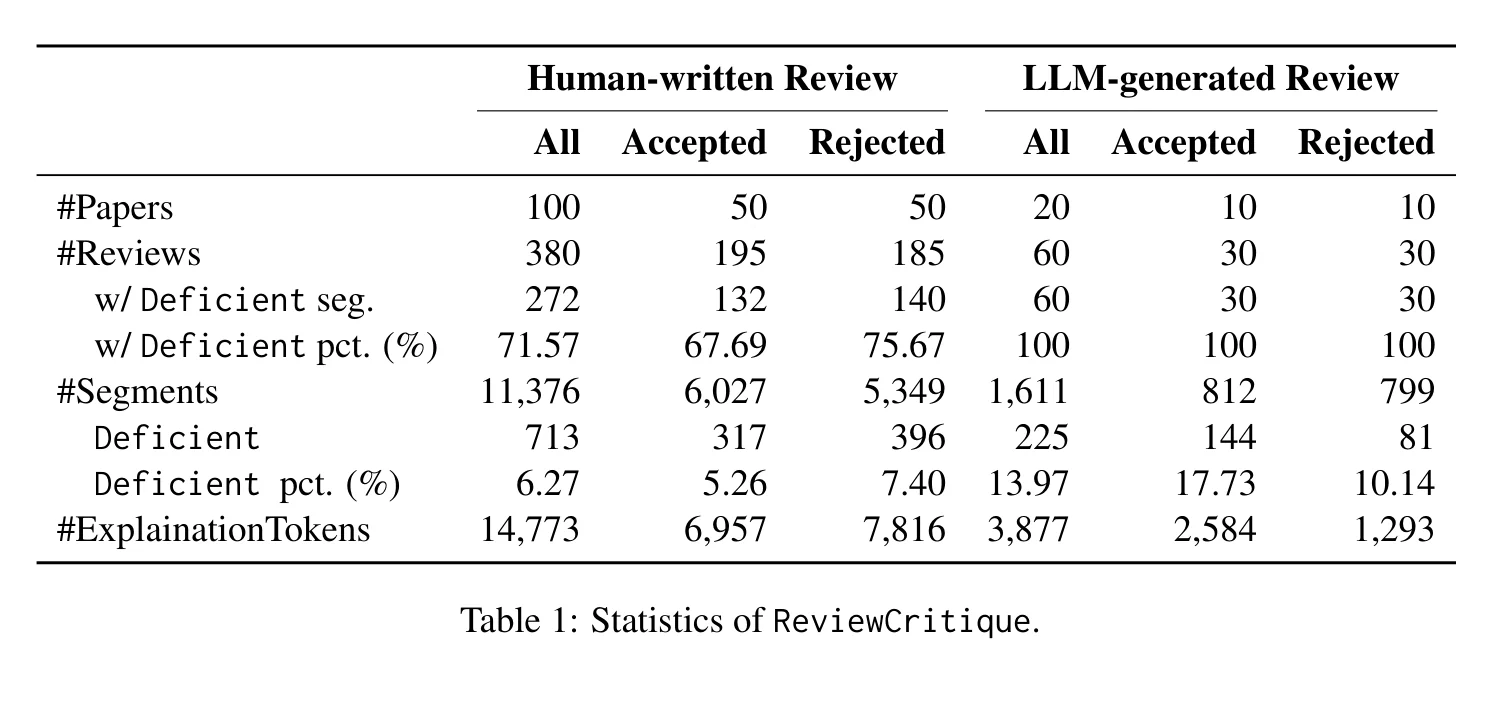
The team created ReviewCritique from reviews of 100 papers submitted to major research conferences. They compared human reviews with reviews generated by GPT-4, Gemini 1.5 and Claude Opus for a 20-paper analysis subset. Forty NLP experts labeled review segments for deficiencies and professionalism. The researchers then tested several closed- and open-weight language models on a separate meta-reviewing task: identifying problematic segments in human-written reviews. They used two prompting strategies, one that labels every segment and another that selects only deficient segments.
This design separates two questions that are often blended together. First, how do model-written reviews differ from reviews by people? Second, can a model recognize flaws in a review after it has been written? The distinction is important because drafting text and making a reliable judgment about its quality are different tasks.
More criticism is not necessarily better criticism
In the annotated segments, LLM-generated reviews contained a larger share of segments marked deficient than human reviews: 13.97% compared with 6.27%. The paper describes model reviews as less specific to the individual paper, less varied and less consistently constructive. Some accepted authors’ claims without testing them critically. Reviewers also noted that models praised writing quality even when expert readers found the writing unclear.
The meta-reviewing experiments found that even leading systems struggled to reach high F1 scores when identifying deficient segments in human reviews. F1 combines precision and recall, so it penalizes a system that either misses many problematic passages or flags too many acceptable ones. This makes the task harder than simply detecting negative tone or generating a confident summary. A system needs to identify a concrete flaw in context and distinguish it from a legitimate difference of interpretation.
The results do not mean every model-generated comment is poor, or that every human review is sound. They show that plausible prose is an unreliable shortcut for review quality. The useful unit of analysis is the particular claim, criticism or suggestion and whether it is grounded in the paper.
Scope and cautions
The work covers NLP papers, not every scientific discipline. Its dataset excludes figures and tables from the submissions, even though visual evidence can be central to a technical argument. The analysis focuses on the pre-rebuttal stage, leaving out the exchanges through which authors and reviewers may clarify misunderstandings. The authors also caution that keeping annotators unaware of whether a review was generated by an LLM cannot guarantee that they remained unaware.
These boundaries matter when applying the findings elsewhere. A review task in experimental biology or medicine may involve different evidence and standards. Likewise, a system that performs poorly on this benchmark might behave differently with access to diagrams or later discussion, but this study does not test those conditions.
Possible implications for practice
For editorial teams and research organizations, the paper suggests that fluent language should not stand in for expert scrutiny. LLMs may help researchers study recurring review problems or organize feedback, but this benchmark gives no basis for delegating consequential judgments to them. A careful evaluation would need to measure paper-specific accuracy, helpfulness and fairness, alongside the ability to identify unsupported claims. That is a higher bar than producing text that sounds like a reviewer.
The authors’ central contribution is comparative evidence about limits, not a proposal for automated peer review. Their article appeared in the 2024 EMNLP proceedings. The PDF’s author order is followed here, including Ranran Haoran Zhang as printed in the proceedings.
Bibliography & sources
- Jiangshu Du, Yibo Wang, Wenting Zhao, Zhongfen Deng, Shuaiqi Liu, Renze Lou, Henry Peng Zou, Pranav Narayanan Venkit, Nan Zhang, Mukund Srinath, Ranran Haoran Zhang, Vipul Gupta, Yinghui Li, Tao Li, Fei Wang, Qin Liu, Tianlin Liu, Pengzhi Gao, Congying Xia, Chen Xing, Cheng Jiayang, Zhaowei Wang, Ying Su, Raj Sanjay Shah, Ruohao Guo, Jing Gu, Haoran Li, Kangda Wei, Zihao Wang, Lu Cheng, Surangika Ranathunga, Meng Fang, Jie Fu, Fei Liu, Ruihong Huang, Eduardo Blanco, Yixin Cao, Rui Zhang, Philip S. Yu, Wenpeng Yin. 2024. LLMs Assist NLP Researchers: Critique Paper (Meta-)Reviewing. In Proceedings of the 2024 Conference on Empirical Methods in Natural Language Processing, pages 5081–5099. Association for Computational Linguistics. https://doi.org/10.18653/v1/2024.emnlp-main.292.