
AI and data work
LLMs Can Help Build Training Data, With Quality Checks
A survey maps how language models can create labels and examples, how teams assess them, and where synthetic data can introduce new risks.
Data teams spend substantial time labeling examples, writing instructions and assembling feedback for machine-learning systems. Large language models can produce some of that material quickly. A survey by Zhen Tan and colleagues maps the work involved and makes clear that generation is only one part of the process.
From prompts to training data
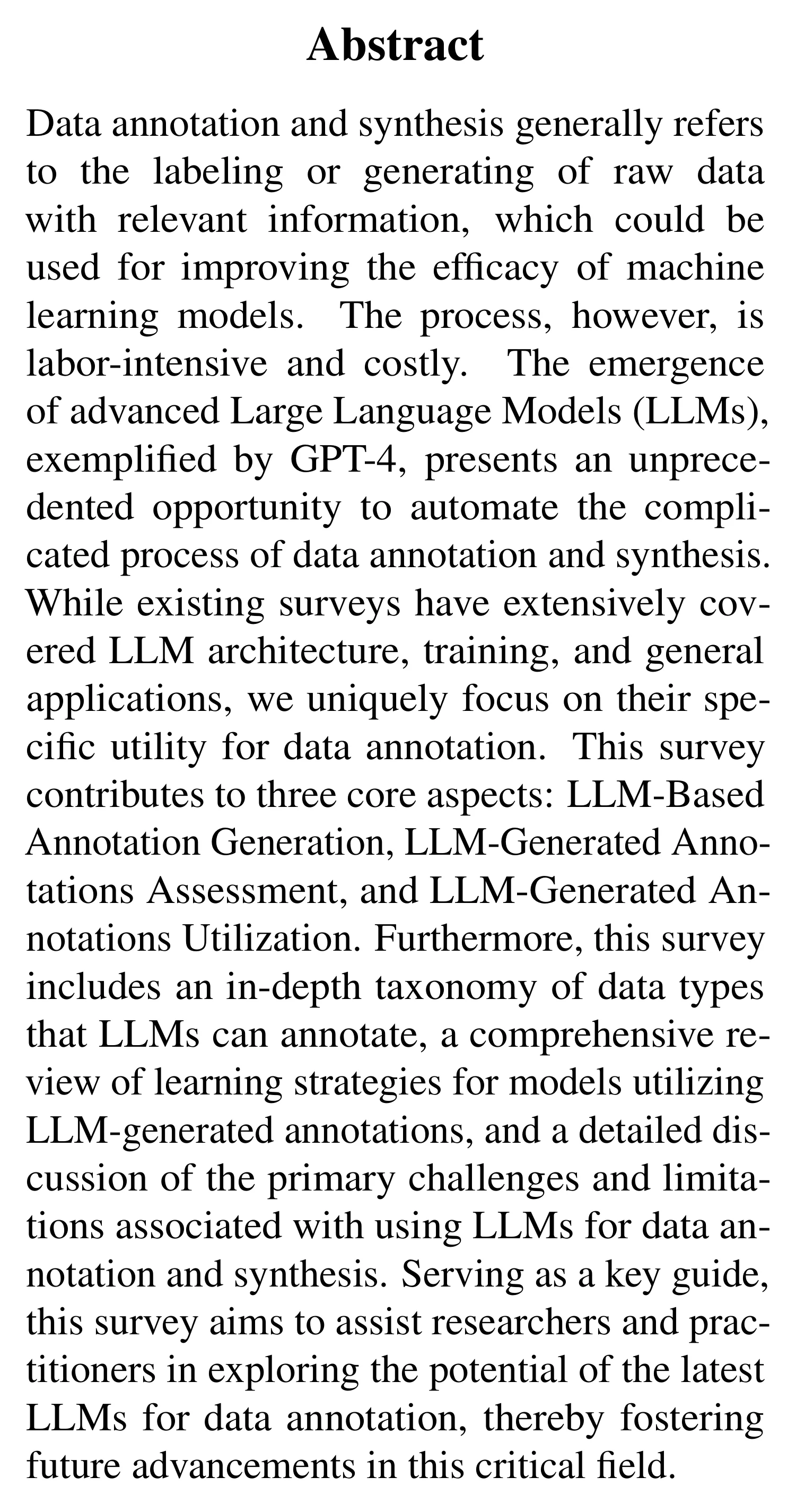
The authors review research on using large language models (LLMs) to annotate and synthesize data. They organize the field into connected stages: generating annotations, assessing quality, selecting useful outputs and using them to train or guide other models. Examples include instruction-and-response pairs, class labels, rationales, preference comparisons and text feedback. The survey also discusses domain-specific data and different learning tasks (Tan et al., 2024, pp. 930–936).
The map helps explain why “AI-generated data” is not one standardized product. A model might label existing text, write new examples, explain a label, or compare two candidate responses. Each task has its own definition of a good answer. A preference label, for instance, depends on which qualities the evaluator values. A fluent rationale can still fail to capture why a label is correct.
Quality work moves downstream
The survey describes several ways researchers assess and select outputs. They use human review, task-specific metrics, comparisons among candidate annotations and language models acting as judges. Filtering can rely on rules, external evidence or model judgments. After selection, annotations may support supervised fine-tuning, alignment training or in-context examples—demonstrations placed in a prompt rather than added to a model’s parameters (pp. 936–938).
These stages form a chain. If an annotation has an error, a filter may keep it, and training can teach a model to repeat it. If examples are easy for a model to produce but unlike later cases, a larger dataset may still fail to improve performance. The review treats diversity and quality as design concerns, not just volume (pp. 931–938).
The sources of risk
This is a survey of prior work, not a new controlled test of one annotation system. Its authors identify recurring constraints: biased or hallucinated outputs, dependence on strong seed data, difficult prompt and tuning choices, overfitting, and substantial computing needs (pp. 938–939). Synthetic annotations can carry forward stereotypes embedded in the model or source data. A label that looks consistent across many examples can still be systematically wrong.
These constraints also shape who can use the methods. The most capable models and repeated human checks may be costly. The survey describes many approaches, but offers no single measure for comparing annotation pipelines on cost, accuracy and downstream value. Results from different tasks and papers should not be treated as interchangeable.
Possible implications for practice
For organizations, the central signal is that language models can shift annotation work rather than remove it. People may spend less time producing first drafts and more time defining quality, reviewing edge cases and monitoring what a training set teaches. A credible claim of efficiency needs to include the checking process, source material and performance on cases outside the model’s examples.
This framing could also change how data budgets are discussed. The question becomes whether generated examples improve the intended task after review, not simply how many examples a model can create. Where labels affect people or consequential services, measuring error patterns and representation may matter as much as average accuracy. The survey leaves open how organizations should balance these costs across applications; that depends on the task and the harms of a wrong label.
A useful way to read the paper is as a workflow map rather than an endorsement of automation. It helps teams locate decisions that otherwise disappear inside a “synthetic data” label: who defines the target, which examples are reviewed, how disagreement is resolved and whether a downstream model actually benefits. Those questions connect annotation choices to organizational accountability. The survey’s breadth makes it useful for framing them, while its lack of a single comparative experiment means local evidence remains necessary.
Bibliography & sources
- Zhen Tan; Dawei Li; Song Wang; Alimohammad Beigi; Bohan Jiang; Amrita Bhattacharjee; Mansooreh Karami; Jundong Li; Lu Cheng; Huan Liu. 2024. “Large Language Models for Data Annotation and Synthesis: A Survey.” In *Proceedings of the 2024 Conference on Empirical Methods in Natural Language Processing*, 930–957. Association for Computational Linguistics. https://doi.org/10.18653/v1/2024.emnlp-main.54.