
Science and research
AI-generated Related Work and Citation Text: A Survey
A survey of 20 studies compares automated related-work writing, from sentence selection to full sections, and examines how the output is evaluated.
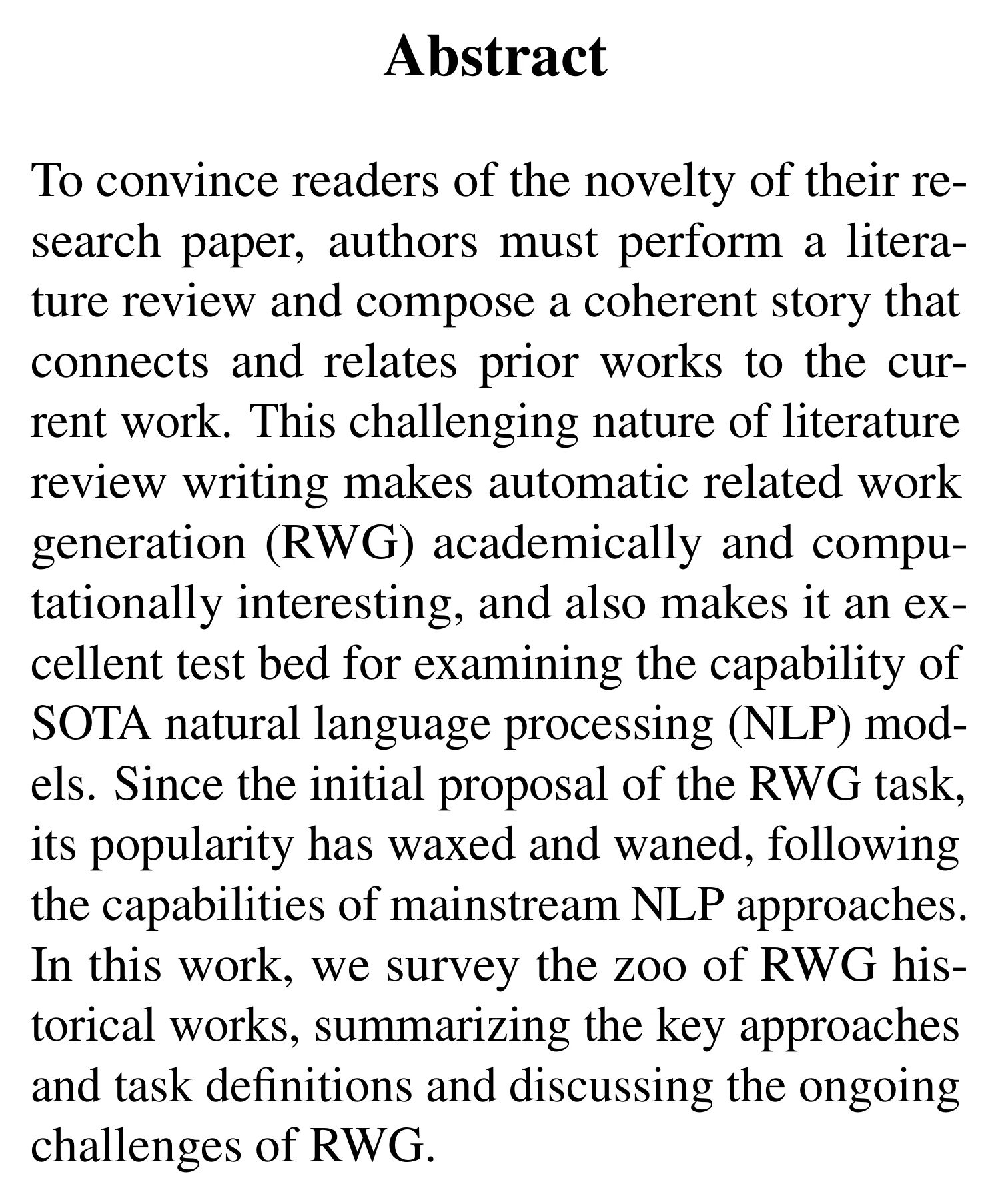
A related-work section has to do more than list papers. It tells readers how previous ideas connect to a new study, which results matter and where a contribution fits. In “Related Work and Citation Text Generation: A Survey,” Xiangci Li and Jessica Ouyang review efforts to automate this writing task, tracing approaches from extractive summaries to systems that generate whole sections.
One task, several definitions
Related-work generation (RWG) has been approached at different levels. Extractive systems select and combine existing sentences. Citation-level systems generate text around individual references. Section-level systems try to produce a coherent multi-paragraph survey. Some use abstracts as stand-ins for full papers; others draw on cited text spans or retrieval systems to gather evidence. Large language models have added new ways to synthesize the material, while human-in-the-loop designs ask people to guide or revise the output.
The survey compares 20 research papers, their task definitions, data and evaluation methods. That comparison reveals why it is difficult to declare one system the clear winner. Studies do not always ask the same question, provide the same inputs or produce the same kind of output. Some assume the system already knows which papers belong in the section. Others select papers and compose text. Their scores therefore reflect different tasks.
Coherence is more than fluent prose
The authors describe a recurring challenge: systems can summarize individual papers without explaining how those studies relate to one another. Human readers often prefer an integrative narrative supported by citations that clarify the role of each source. Yet models may struggle to order and group references, identify the most important findings, and write transitions that connect one paper to the next.
Evaluation also remains uneven. Many systems report automatic text-overlap scores such as ROUGE, while others add manual ratings of fluency, coherence and relevance. These measures capture different qualities. A generated paragraph may reuse the same words as a reference without making a sound comparison, while a useful synthesis may use different wording. Human evaluation can probe higher-level quality, but its criteria and scale vary across studies.
The survey is therefore valuable less as a single leaderboard than as a field guide to methodological fragmentation. It shows that a system’s performance must be interpreted in light of what it was asked to do and which evidence it could use.
Open problems and risks
The review identifies recurring assumptions that may not match scholarly work. Some systems rely on a known list of cited papers, which removes the discovery problem. Citation order and grouping remain difficult, and fluent transition sentences are hard to generate. Abstractive systems also create risks of factual hallucination and plagiarism if claims are not tied carefully to sources. Academic writing raises questions about authorship and appropriate use of generated text.
The survey notes that existing results are hard to compare because datasets, task definitions and evaluation protocols differ. Some research systems or outputs are not released, further limiting replication. The survey itself is also a selective synthesis rather than a new, standardized benchmark. Its conclusions describe patterns across the literature, not a controlled experiment showing that one strategy works best in all settings.
Possible implications for practice
For research teams and organizations that produce evidence reviews, automated drafting could help organize large reading lists, but the central work of interpretation remains. The survey suggests that future tools should make source relationships visible, distinguish evidence from generated connective prose and support review by domain experts. More consistent benchmarks would help show whether a system can create a genuinely coherent account rather than a collection of locally plausible summaries.
This survey appeared in the 2024 EMNLP proceedings. It presents a useful map of related-work generation, while making clear that the field still lacks shared definitions and dependable ways to compare systems.
Bibliography & sources
- Xiangci Li, Jessica Ouyang. 2024. Related Work and Citation Text Generation: A Survey. In Proceedings of the 2024 Conference on Empirical Methods in Natural Language Processing, pages 13846–13864. Association for Computational Linguistics. https://doi.org/10.18653/v1/2024.emnlp-main.767.