
AI governance and society
Testing AI copyright safeguards under pressure
SHIELD combines a copyright benchmark, jailbreak tests and a prototype defense to examine both unwanted copying and over-refusal by language models.
A language model can face two opposite copyright problems: repeating protected material or refusing a request for a work that is in the public domain. Liu and colleagues build an evaluation framework around both risks, then test how safeguards respond when users try to bypass them. Their work matters to organizations that generate text at scale and need clearer evidence about system behavior.
A benchmark and a defense prototype
SHIELD combines three elements: a curated dataset for evaluating copyright compliance, attack strategies that test model safeguards, and a lightweight defense mechanism. The evaluation distinguishes requests involving copyrighted works from requests involving public-domain text. It also includes jailbreak attempts: prompts designed to get around a model’s normal restrictions.
The proposed defense uses a copyright-material detector, a copyright-status verifier and a guide that directs the model’s response. The detector checks for text overlap with material in its database. The verifier checks the status of the material, and the guide supports decisions about whether the model should answer or refuse. The paper evaluates multiple models and defenses on the constructed datasets and reports overlap-related measures and refusal behavior (framework and experimental setup, proceedings pages 1646–1654).
Safeguards can fail in both directions
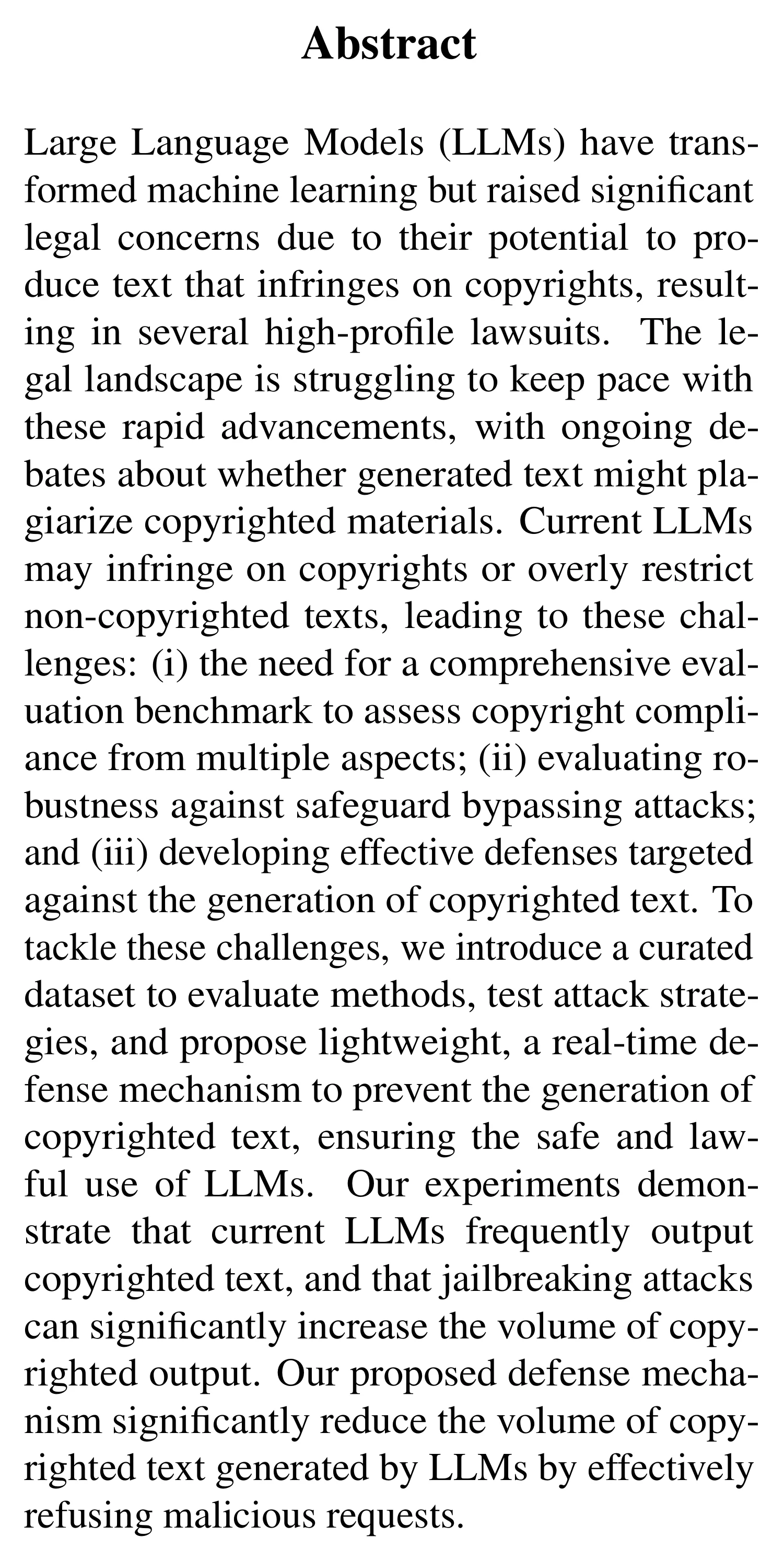
The authors report that tested models sometimes produce copyrighted text and can overprotect public-domain works. Jailbreak attacks increase the amount of copyrighted text generated. In their experiments, the SHIELD defense significantly reduces copyrighted output by refusing malicious requests, while retaining the distinction between protected and public-domain content as an explicit design goal (abstract, proceedings page 1640; evaluation and conclusion, pages 1657–1664).
This is an evaluation of model outputs under controlled prompts. It does not determine whether a particular output is legally infringing, a question that can depend on facts beyond textual similarity. Nor does it resolve broader questions about the lawfulness of training data or the legal status of all generated content.
A practical risk signal
For teams that use generative systems in publishing, customer support or product content, SHIELD offers a way to think about safeguards as a system that must distinguish among requests. A defense that catches likely reproduction but blocks harmless or public-domain requests can frustrate legitimate work. Testing both false negatives and false refusals may give a more complete picture than a single refusal-rate target.
The evaluation spans 450 items in five benchmark categories and 76 jailbreak attacks; eight commercial and open-weight models were tested. SHIELD raised refusal rates to about 100% for API models and above 70% for other tested models, outperforming MemFree decoding. Direct probing also showed a split: Claude-3 and GPT-4o refused 98–100% of BS-C requests, while GPT-3.5 Turbo and Llama-3 often returned verbatim material. This is a bounded benchmark, not proof that copyrighted output is eliminated in deployment (§4; Tables 1–5).
Study limits
The authors say their evaluation does not cover every model or copyrighted work. SHIELD is a prototype, not a production-ready defense. Its n-gram detector—the technique that flags overlapping word sequences—depends on a maintained database and can be confused by similar text. The copyright-status verifier relies on an online service, and keeping cached status current creates additional engineering challenges (limitations, proceedings pages 1664–1665).
Possible implications for practice
The study suggests that copyright safeguards can be evaluated as a balance between preventing reproduction and preserving legitimate access. For organizations, the possibility of a layered detector and status check may inform future review of text-generation controls. Further evidence would be needed to assess coverage, latency and legal accuracy across a wider range of works and real-world requests.
Bibliography & sources
- Xiaoze Liu, Ting Sun, Tianyang Xu, Feijie Wu, Cunxiang Wang, Xiaoqian Wang, and Jing Gao. “SHIELD: Evaluation and Defense Strategies for Copyright Compliance in LLM Text Generation.” In Proceedings of the 2024 Conference on Empirical Methods in Natural Language Processing, 1640–1670 (2024). https://doi.org/10.18653/v1/2024.emnlp-main.98.