
AI and social simulation
Systematic Biases in LLM Simulations of Debates
Language-model agents assigned opposing political identities shifted toward the base model’s views during simulated debates.
When simulated debate takes on a model’s own politics
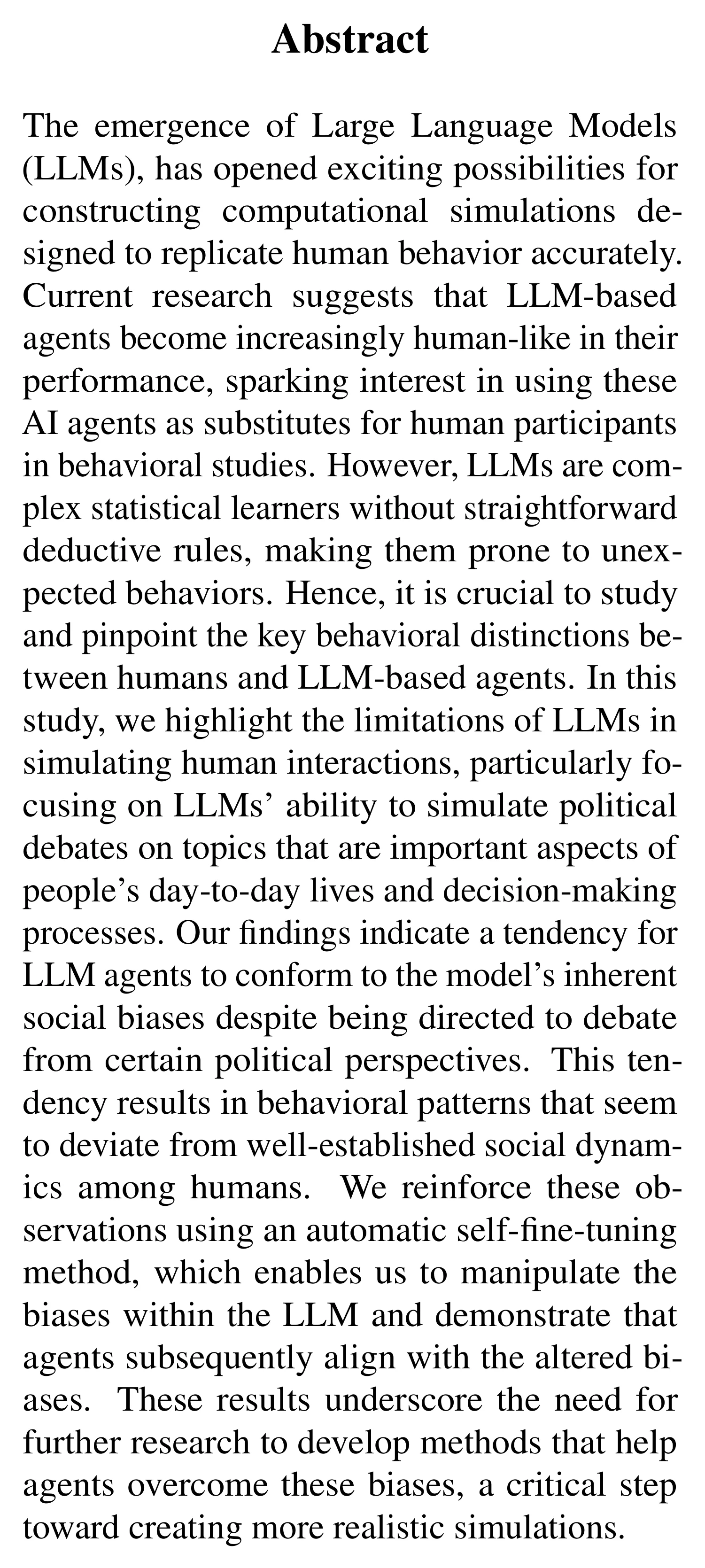
A simulated political debate can look convincing while behaving unlike a debate between people. In a study of language-model agents assigned Democratic and Republican personas, the authors find that participants’ stated positions often drift toward the base model’s own political leaning. The model’s default tendency can shape the entire simulation, even when each agent has a detailed identity prompt.
The researchers tested four contentious U.S. issues: gun violence, racism, climate change and illegal immigration. They created 40 personas for each party and ran repeated dialogues using GPT-3.5-turbo-instruct, with Mistral 7B and Solar 10.7B as additional base models. Agents rated how serious they believed an issue was on a 0–10 scale before and during discussion. Each simulation was repeated 40 times with different personas and sampled dialogue. These are repeated model runs, not a sample of 40 human conversations.
The default model becomes an invisible participant
In three-way discussions, a neutral “default” agent represents what the underlying model says when given no partisan identity. The partisan agents’ ratings tended to move toward that default position. The pattern persisted when the default agent was removed from the dialogue: Democrats and Republicans still shifted toward the model’s underlying lean. Same-party dialogues also moved toward moderation rather than intensifying positions in the way the authors expected from real-world echo chambers. These patterns appear across the four topics, although the size and direction of change varied. See pages 255–257 and Figures 3–5.
A further intervention strengthens the case that the base model matters. The authors used a self-training method to shift Mistral’s political responses, then reran debates with the original persona prompts. The agents’ behavior shifted along with the fine-tuned model. This result suggests that a persona instruction alone may not reliably override a model’s acquired tendencies. It also demonstrates a possible way to manipulate a simulation’s direction without changing the agents’ visible identity descriptions.
Bias and task performance can move together
The researchers also examined standard benchmarks after fine-tuning. Stronger next-word training toward the Republican viewpoint reduced Mistral’s reported Hellaswag score from 83.6% to 73.8% and MMLU from 59.0% to 48.6% in one setting (Table 1, page 257). A preference-optimization step partially recovered these scores. The experiment does not show that political adaptation must cause the same losses in every model, but it does make clear that the intervention was not isolated to the attitude measure.
The scope is narrow: the debate simulations use generated American partisan personas and four selected issues, and their attitude scores are model reports rather than human survey responses. The dialogue system, prompting choices and model family also affect the results. These limits matter because the paper studies how a particular simulation behaves, not whether political conversation in general changes people’s beliefs.
What this means for social simulation
For organizations using simulated agents to examine public opinion, negotiation or group behavior, this work raises a measurement question: whose preferences are being represented—the assigned persona, or the base model that speaks through it? Researchers may need to disclose model identity and baseline tendencies alongside the persona design. The fine-tuning result further suggests that a simulation’s output can change when its foundation model changes, even if its fictional characters stay constant. Real-world human studies remain necessary before drawing conclusions about how people themselves respond.
Bibliography & sources
- Amir Taubenfeld, Yaniv Dover, Roi Reichart, Ariel Goldstein. 2024. “Systematic Biases in LLM Simulations of Debates.” In *Proceedings of the 2024 Conference on Empirical Methods in Natural Language Processing*, 251–267. Association for Computational Linguistics. https://doi.org/10.18653/v1/2024.emnlp-main.16.